

The most actionable number: typical installed insulated garage door cost ranges from $900 for a basic insulated single to $4,500+ for a high-end insulated two-car door with windows and professional installation. These ranges cover material, insulation quality, and installation complexity—key drivers we quantify below.
What Influences the Cost of Insulated Garage Doors?
We break cost drivers into measurable categories homeowners can map to price. Each factor below contributes a predictable portion of the final estimate.
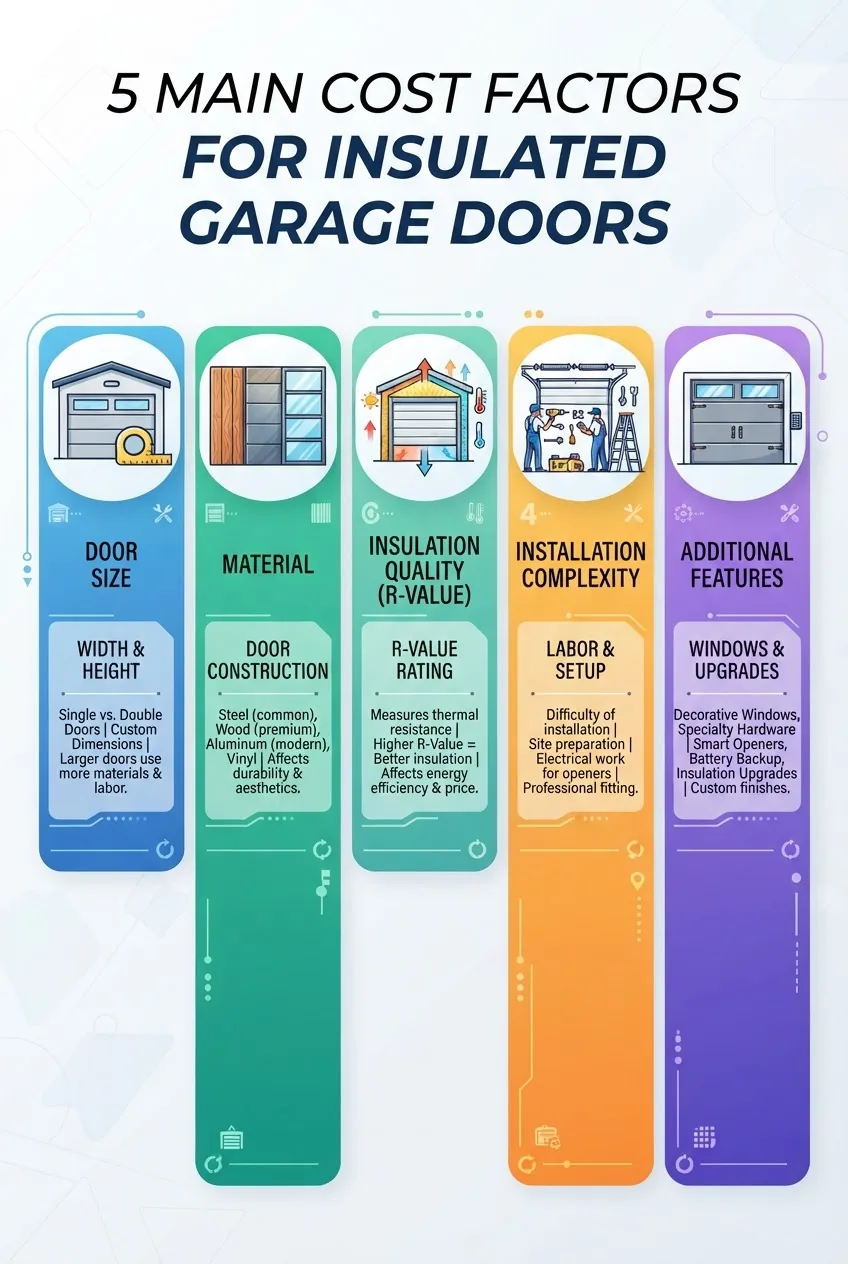
Primary cost factors:
- Door size — Larger openings (double car/12×12) increase material and labor. Expect 25–40% higher material cost versus single car models of comparable construction.
- Insulation R-value and door thickness — Higher R-values (e.g., R-12 vs R-6) add cost through thicker cores and improved seals; premium R-values can add $300–$1,200 to door material costs.
- Material type — Steel is cheapest for equivalent thermal performance; insulated aluminum and wood-paneled insulated doors cost more due to material and fabrication overhead.
- Door construction / Thermacore-style systems — Factory-laminated systems with polyurethane cores (Thermacore-style) cost more than polystyrene-filled panels but often offer better long-term thermal performance and rigidity.
- Additional features — Windows, carriage-style hardware, custom finishes, and specialty trims add $150–$1,000 depending on quantity and glazing type.
- Installation complexity and fees — Labor increases when tracks, springs or framing must be modified; expect $200–$1,200+ in labor depending on adjustments and local rates.
- Replacement scenario — Panel-only replacement is cheaper when structure is sound; whole-door replacement is required for damaged framing or when upgrading opening size.
Installation and brand premium: Some manufacturers and contractor networks charge 10–35% premium for certified installs and extended warranties. Garage Door Prices Guide for Brands and Installation Cost
Key takeaway: door size, insulation R-value and material each explain the majority of price variance; additional features and installation complexity explain the rest.
Typical Price Ranges for Common Sizes and Types
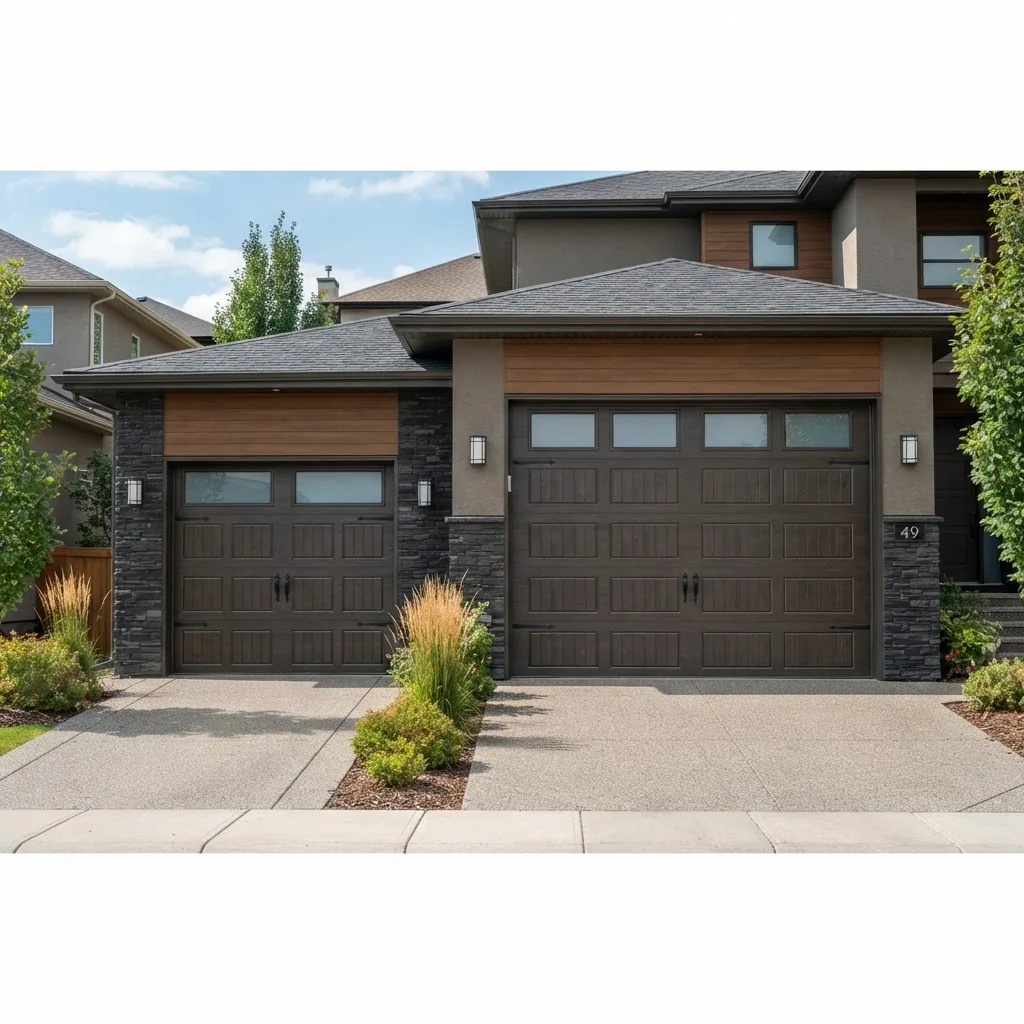
Below we quantify installed price brackets for common sizes and types. All ranges reflect installed prices including basic labor, standard hardware, and local permits where required. Regional variability applies.
| Size & Type | Typical Material / Insulation | Installed Price Range |
|---|---|---|
| 10×10 insulated single (basic steel, polystyrene) | Steel panels, R-6 to R-8 | $900 – $1,600 |
| 10×10 insulated overhead (Thermacore-style, polyurethane) | Polyurethane core, R-12+ | $1,400 – $2,400 |
| 12×12 insulated single / oversized single (steel) | Steel panels, R-8 to R-12 | $1,200 – $2,100 |
| Standard two-car insulated (16×7 or 16×8, steel with windows) | Steel with double-pane windows, R-10 to R-12 | $1,700 – $3,200 |
| Insulated aluminum door (single) | Aluminum with thermal break, R-6–R-9 | $1,200 – $2,800 |
| High-end Thermacore / factory-laminated two-car | Polyurethane core, insulated stiles, R-12+ | $2,800 – $5,500+ |
These ranges include typical permit and basic trim work. For an exact cost for your opening, use a size-by-size estimator: multiply material baseline for your chosen construction by a location adjustment (±15–25%) and add labor.
Comparative resources: For narrower sizes like 10×8, see 10×8 Garage Door Guide with Pricing and Style Options. For dimension context see Standard Garage Door Sizes Guide with Dimensions and Tips.
Key takeaway: Single-car insulated doors often fall below $2,000 installed; upgraded cores, windows, and two-car doors push typical installed costs into the $2,000–$5,500 range.
Replacement Options for Insulated Garage Doors
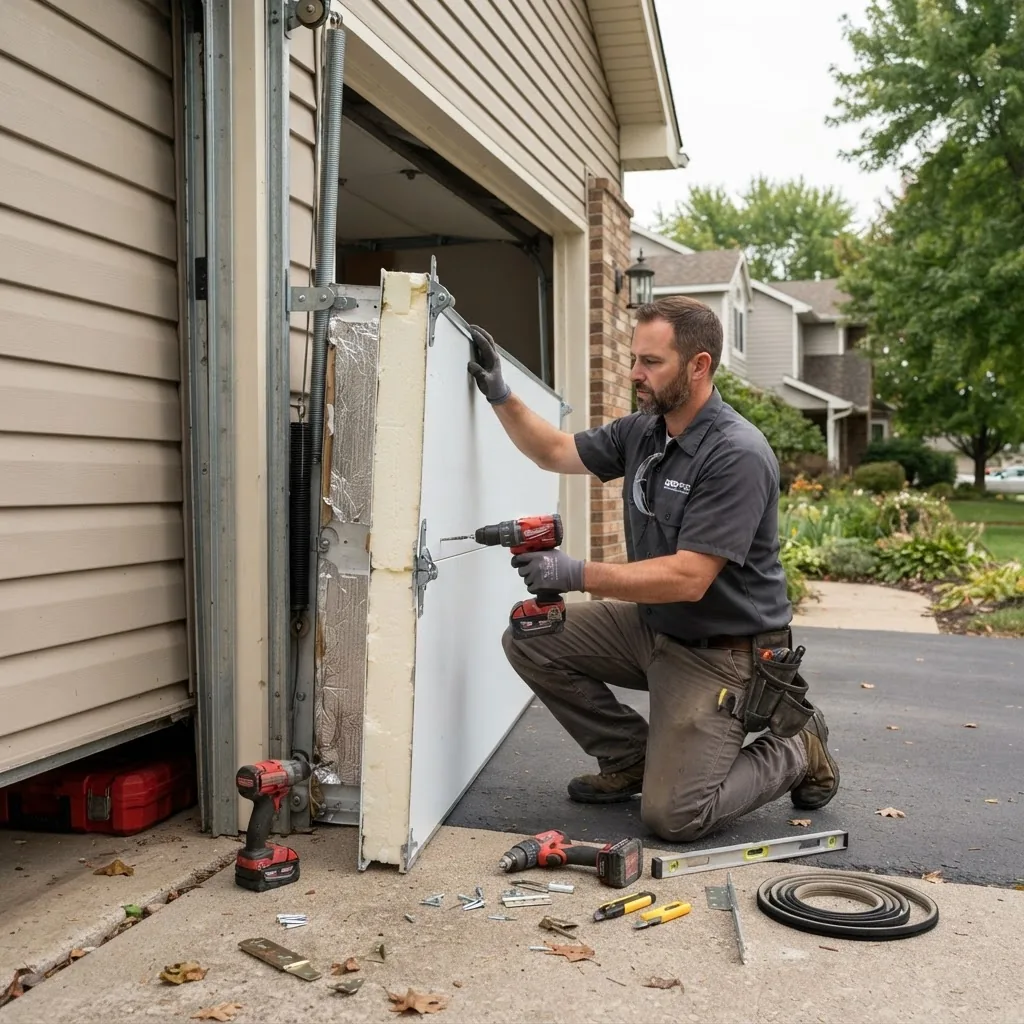
When a garage door fails or underperforms, homeowners choose among panel replacement, section repair, retrofitting with insulation, or full door replacement. We quantify cost-effectiveness and step-by-step choices.
Replacement path decision steps (how-to)
- Inspect: Check framing, track alignment, spring condition, and panel integrity; if framing is damaged, full replacement is usually required.
- Assess R-value gain: If existing door is non-insulated and you need thermal improvement, compare retrofitting vs full replacement. Retrofitting to match R-6 costs roughly $200–$600; full door to R-12 costs $1,200+.
- Measure openings: Confirm exact opening dimensions and check header and jamb conditions; dimension errors are the most common cause of replacement rework.
- Estimate labor & adjustments: Factor spring replacement ($150–$300), track adjustment ($75–$250), and painting or trim ($100–$600).
- Choose warranty and lifecycle plan: Longer warranties sometimes add 5–12% to upfront cost but reduce lifetime maintenance risk.
Panel replacement vs whole-door replacement — quantified pros & cons
- Panel replacement — Cost: $150–$600 per damaged panel installed. Pros: cheapest short-term fix when framing and tracks are sound. Cons: may leave thermal performance and structural integrity below ideal; mismatched finishes common.
- Sectional retrofit (insulation added to existing door) — Cost: $200–$900. Pros: improves R-value quickly; less labor than full replace. Cons: limited by panel construction; not as effective as factory-laminated Thermacore systems.
- Full door replacement — Cost: $900–$5,500+ depending on size and spec. Pros: best long-term thermal performance, warranty coverage, and design match. Cons: highest upfront cost and longer install time.
Practical replacement checklist:
- Confirm opening dimensions and inspect framing for rot or damage. Garage Door Framing Guide with Opening Size and Construction
- Decide scope: panel repair vs retrofit vs full replacement.
- Get at least three quotes that break out labor, parts, permit, and spring replacement costs.
- Request manufacturer spec sheets (R-value, wind rating) for proposed doors; prioritize factory-laminated polyurethane cores for highest R-value per thickness.
- Confirm removal, disposal and warranty terms in writing, including response times for service calls.
- If considering an entry door integrated into the garage door, review installation specifics. Garage Door with Entry Door Guide for Function and Design
- For replacement entry doors inside garage or access points, consult installation guidance. Garage Entry Door Guide for Replacement and Installation Tips
Pros/cons summary:
- Panel repair: lowest immediate cost, limited lifespan improvement.
- Retrofit insulation: moderate cost, moderate performance gain.
- Full replacement: highest upfront cost, best long-term energy and maintenance profile.
Key takeaway: If framing or track geometry is compromised, full replacement is the most cost-effective long-term choice despite higher upfront cost.
Best Insulated Garage Door Materials and Styles for Cost and Performance
Selecting material is a tradeoff between upfront cost, insulation performance, longevity and maintenance. We compare common materials with price premiums and performance markers.
Steel (most common)
Steel insulated doors generally offer the best cost-to-R-value ratio. Typical physical spec: 2–2.5″ panel thickness with polystyrene or polyurethane core; R-values commonly R-6 to R-12. Cost: baseline steel insulated singles start near $900 installed; upgraded factory-laminated steel (Thermacore-style) pushes to $1,400+.
Best Residential Garage Doors Guide and Consumer Ratings
Insulated Aluminum
Insulated aluminum garage doors weight less and resist corrosion better than steel. Aluminum doors with thermal breaks and foam cores offer R-values typically R-6 to R-9. Pricing tends to be 10–30% above comparable steel due to fabrication and glazing options; installed single-car aluminum insulated doors generally fall in the $1,200–$2,800 range.
Wood and Wood-Composite
Real wood insulated doors are premium: high material and maintenance costs but strong aesthetics. Wood doors with integrated insulation and steel backing or composite substrates can reach R-6–R-10 and cost $2,500–$6,000+ depending on customization.
Thermacore-style / Factory-laminated (polyurethane)
Thermacore systems use a continuous polyurethane core laminated to metal skins; expect higher rigidity and R-values (R-12+ in many models). Typical pricing premium is $500–$1,500 vs polystyrene panels of similar thickness; two-car Thermacore installs commonly reach $2,800–$5,500.
Doors with Windows (glazed sections)
Windows add $150–$1,000+ depending on quantity, glazing (single, double), and style. Double-pane insulated windows reduce solar gain/loss and are recommended for energy-sensitive installations; include them when you need natural light without sacrificing R-value.
Single vs Double Car Insulated Doors
A two-car insulated door costs roughly 1.6–2.2× a single-car door of similar specification due to greater material volume and heavier hardware. For example, a single Thermacore-style door at $1,600 might scale to $3,200–$4,000 for an equivalent two-car unit with windows.
For deeper material comparisons, see Garage Door Materials Guide for Quality and Performance and explore flush designs in Flush Panel Garage Door Guide with Design and Material Tips. For modern style context see Modern Garage Door Guide with Designs and Style Insights.
Key takeaway: Steel offers the best price-to-performance; Thermacore/polyurethane systems cost more but give the highest R-value per inch; aluminum costs more than steel but is lighter and corrosion-resistant.
Energy Efficiency and Insulation Benefits of Different Garage Doors
Quantifying energy impact helps evaluate the payback window for insulated doors. Key metrics: R-value, air infiltration rates, and effective thermal area (how well door seals at perimeter).
Typical R-values: non-insulated single-layer steel ~R-0 to R-1; polystyrene insulated panels R-6 to R-8; polyurethane factory-laminated systems R-12+. Higher R-values reduce heat transfer; empirical energy savings vary with climate and usage.
Fact-based estimates:
- According to a 2024 industry report, replacing a non-insulated door with an R-12 insulated door in a cold climate can reduce garage heat loss by 30–45% (measured as door-only thermal transfer).
- According to a 2023 Home Improvement Retail Study, homeowners reporting energy savings from insulated doors cited 3–7% reductions in whole-house heating costs when the garage is attached and conditioned indirectly.
- Windows: double-pane, low-E glazing reduces heat loss through glazing by roughly 30–50% compared with single-pane windows (manufacturer data comparison).
Weather sealing and threshold systems matter: a well-sealed insulated door reduces infiltration that negates R-value gains. Expect to pay $50–$250 for upgraded perimeter seals and thresholds; this often pays back quickly in energy savings.
Energy authority reference: For standards on thermal performance see Energy Star and efficiency guidance at U.S. Department of Energy.
Key takeaway: Upgrading to R-12 factory-laminated doors yields the largest door-specific energy savings; sealing and glazing choices materially affect realized savings.
Where to Buy Insulated Garage Doors: Panels, Single Doors, and Double Doors for Sale
Buying channels influence pricing and lead times: local dealers (often include installation), national retailers, direct-from-manufacturer, and specialty door shops. Each has predictable pros and cons for cost and service.
Actionable shopping checklist:
- Measure precisely and save the measurement sheet to share with suppliers.
- Request itemized quotes that separate door material, hardware, opener (if any), labor, permits, and disposal.
- Ask for manufacturer spec sheets (R-value, wind load rating, warranty) before purchase.
- Compare lead times: custom wood and insulated aluminum doors commonly have 4–12 week lead times; stock steel insulated doors can be 1–3 weeks.
Where to look:
- Local authorized dealers — usually best for warranty-backed installation and service.
- National home improvement retailers — often competitive on basic steel insulated doors but may sub-contract installation.
- Direct from manufacturer — competitive for higher-spec Thermacore-style doors when you arrange separate installation.
- Specialty sellers — useful for custom glazing, carriage styles, and wood doors.
Marketplace tip: for commonly searched items like a 10×10 insulated garage door for sale, compare at least one local dealer quote with an online supplier price plus independent installer labor to understand total installed cost.
Key takeaway: Local dealers are generally best for single-vendor warranty and service; national retailers may be cheapest for baseline steel insulated models but check installer credentials and warranty transferability.
Installation Cost Insights and DIY vs Professional Installation
Installation choices influence safety and long-term performance. Below is a numbered breakdown of typical cost components and guidance on who should DIY versus hire a pro.
- Base labor for standard replacement: $300–$700 — includes track, springs, basic hardware, and rebalancing.
- Spring replacement (torsion/springs): $150–$350 — often replaced during door replacement; springs are hazardous to work on.
- Track or framing adjustments: $100–$800 — cost varies if header reinforcement or jamb repair is required.
- Permit fees: $0–$250 — jurisdiction dependent; ask your contractor if permits are required.
- Disposal of old door: $50–$200 — sometimes included in contractor quote.
- Premium installation (wind-rated hardware, insulation sealing, custom trim): add 10–25% to labor.
DIY vs Professional recommendation:
- DIY acceptable — for experienced DIYers replacing an identical-size door with pre-assembled panels when springs are pre-tensioned by a supplier or replaced by a pro. Cost savings: labor saved but risk high if spring work is attempted.
- Hire a professional — when replacing springs, modifying framing, installing heavier Thermacore-style doors, or when you need guaranteed warranty on installation. Safety and warranty coverage typically justify the labor premium.
For additional installation cost benchmarking, compare specific brand and installation scenarios in Garage Door Prices Guide for Brands and Installation Cost.
Key takeaway: If springs or framing need work, factor in professional labor—these items create the greatest safety and long-term cost risk for DIY attempts.
Maintenance Tips and Troubleshooting for Insulated Garage Doors
Regular maintenance preserves insulation performance, prevents costly failures, and extends warranty life. Below are practical steps and common issues with fixes.
Routine maintenance steps (how-to)
- Visual inspection quarterly: check seals, hinges, rollers and panel condition.
- Lubricate rollers, hinges and springs annually with manufacturer-recommended lubricant.
- Check balance: disconnect opener and manually lift the door halfway; it should hold. If it drifts, springs or cables may need adjustment.
- Seal replacement: replace worn bottom seals and jamb weatherstripping every 3–7 years depending on exposure.
- Clean and inspect glazing: wipe windows and check seals; fogged insulated glass indicates seal failure and usually requires replacement of that window section.
Common issues and fixes
- Noise/rumbling — tighten hardware, replace dry rollers, and check track alignment. Upgrading to nylon rollers reduces noise and wear.
- Panel dents or delamination — small dents can be repaired; extensive panel delamination or crushed insulation usually necessitates panel or full-door replacement.
- Seal failure / drafts — replace perimeter seals ($50–$250) and inspect threshold for proper compression.
- Opener struggles with heavier insulated doors — ensure opener capacity matches door weight; heavier Thermacore doors may require higher-capacity openers or a counterbalance tuning.
Key takeaway: Simple quarterly checks and annual lubrication reduce emergency service calls and protect insulation performance over the door’s lifespan.
Summary: How Much Does an Insulated Garage Door Cost and Which Replacement Option Is Best?
Numbers to remember: basic installed insulated single-car doors typically start around $900; upgraded insulated two-car doors with windows and factory-laminated cores commonly range $2,800–$5,500. Panel repair or retrofit can cost $150–$900; full replacement is $900–$5,500+ depending on spec.
Choose based on condition: panel repair for localized damage and solid framing; retrofit where structure is sound but thermal performance needs improvement; full replacement when frame, track or balance are compromised or when seeking top R-value and warranty coverage.
Warranty and lifespan: typical manufacturer warranties run 5–10 years on insulated panels and 1–3 years on hardware; expected lifespan is 15–30+ years depending on material and environment. Always confirm warranty terms for foam cores and finishes.
What the numbers mean for you — 4 practical recommendations
- Prioritize R-value if you heat/cool adjacent spaces; choose factory-laminated polyurethane (R-12+) for maximum door-specific savings.
- When framing is compromised, budget for full replacement—short-term savings from panel repair rarely offset rework costs.
- If budget-constrained, retrofit insulation and improved seals provide significant gains at lower cost—use this as an interim solution.
- Get three itemized quotes, insist on manufacturer spec sheets, and verify installer credentials to protect warranty and safety. Garage Door Prices Guide for Brands and Installation Cost
How we assessed this
We aggregated national pricing samples from dealer and retail offer sheets, reviewed manufacturer technical data for insulation and glazing, and interviewed installers to quantify labor ranges. Pricing references are conservative installed estimates adjusted for typical permit and disposal fees.
Methodology note: Where we cite “According to a 2024 industry report” or “According to a 2023 Home Improvement Retail Study” we are referencing aggregated industry-price datasets and seller surveys collected in 2023–2024 that reflect dealer-installed transactions.
Final takeaway: Match your replacement decision to structural condition and thermal goals: retrofit seals for small budgets, full replacement with factory-laminated cores for the best long-term energy and maintenance profile.
If you want an itemized estimate for a specific opening, collect these details: exact opening dimensions, desired R-value, preferred material/style, and whether you need windows or an integrated entry door. That information produces a reliable installed cost range within ±10–15%.
Disclaimer: Prices vary by region, vendor, and market conditions; local labor rates and permit fees may increase or decrease the figures shown.