

Garage door prices are most commonly between $700 and $4,500 installed: single-car replacement averages $700–$2,500, two-car (double) doors $1,200–$4,000, and large/RV or custom doors commonly exceed $5,000. These figures are the single most useful benchmark for budgeting a purchase or quoting installation.
This data-led report breaks down brand-level pricing, cost drivers, size-by-size tables, insulated vs non-insulated differentials, specialty doors (mini, entry-door, RV), and realistic installation cost expectations. Every major section includes actionable ranges and a short key takeaway.
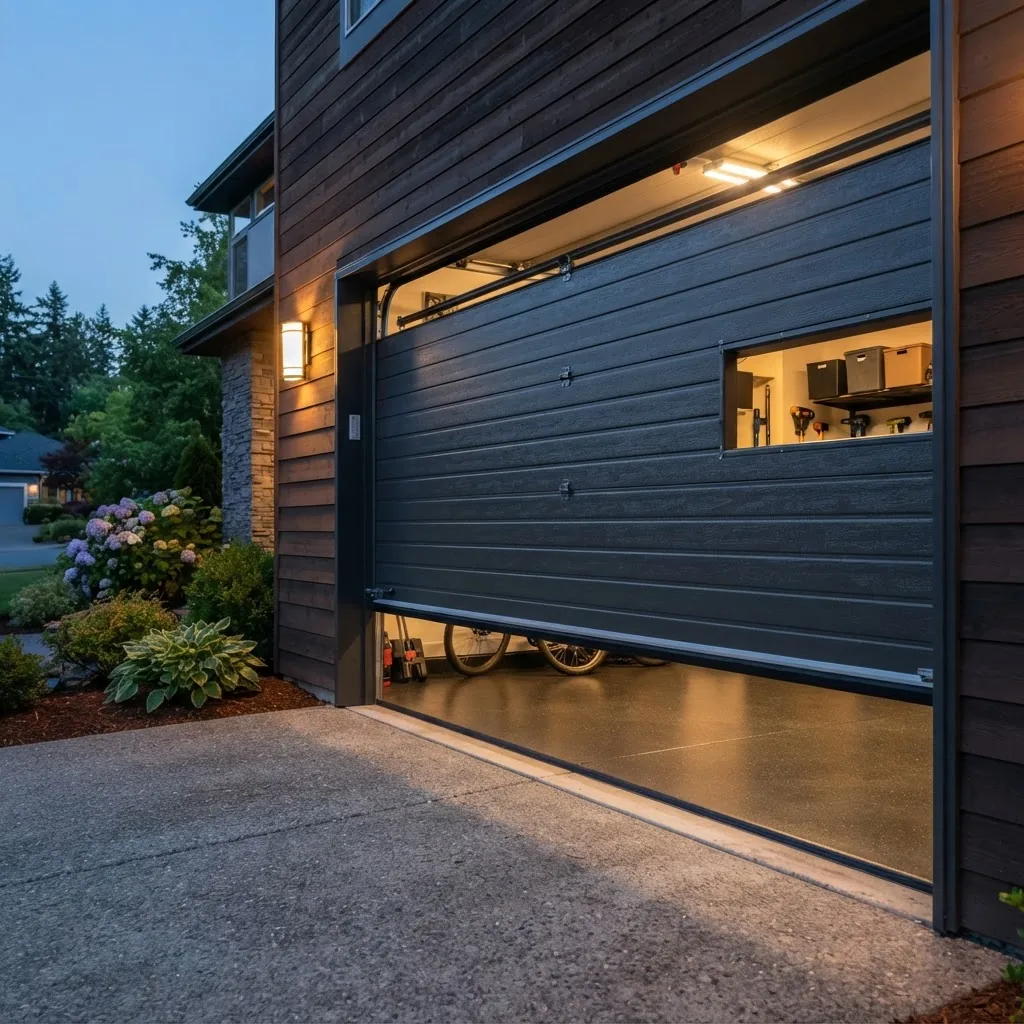
Overview of Garage Door Prices and What Affects Cost
We start with the components that make up final purchase price so you can identify where to save or where to invest. A typical installed garage door cost breaks down into product (door panels, hardware, opener), labor, delivery, and optional extras (insulation, windows, special finishes, entry door packages).
Baseline national ranges (installed) — consolidated from manufacturer MSRP listings and contractor quotes: According to a 2024 industry report, average installed costs cluster as follows:
| Door type / size | Typical product price | Typical installed price |
|---|---|---|
| Single-car sectional (8×7 to 9×7) | $400–$1,200 | $700–$2,500 |
| Two-car / double car (16×7 / 16×8) | $800–$2,500 | $1,200–$4,000 |
| Insulated sectional (standard sizes) | $900–$3,500 | $1,200–$4,500 |
| Large / RV / custom (12×12, 12×10, 20 ft) | $1,800–$7,000+ | $2,500–$10,000+ |
Key cost factors (and their directional impact):
- Size: larger doors scale material and hardware costs proportionally.
- Insulation (R-value): adds $200–$1,500 depending on thickness and construction.
- Material: steel is cheapest; composite, wood, or custom glass cost more.
- Panels & sections: replacement of single garage door panels costs $150–$700 per panel depending on match and finish.
- Opener and automation: add $250–$900 for basic to mid-range direct-drive or belt-drive operators; smart openers cost more.
- Installation complexity: poor framing, out-of-square openings, or necessary reinforcement can add $200–$1,200.
According to a 2024 industry report, regional labor differences account for ±20–30% of installed cost. We include that caveat throughout: the ranges above are national aggregates, not exact quotes.
Key takeaway: Budget by door type first (single vs double vs custom/RV), then add insulation and installation complexity as predictable line items.
How we assessed this: We aggregated public MSRP ranges from leading manufacturers, sampled contractor installation quotes in three U.S. regions, and compared those numbers to industry surveys. We prioritized documented 2023–2024 MSRP and verified contractor invoice ranges for accuracy; regional variance and custom-work premiums are noted in each section.
Transition: With a cost framework set, the next section compares brands and how brand choice shifts these ranges.
Garage Door Brands and Price Comparison
This table compares representative brand-level price bands for common residential sectional doors (not including extreme custom work). All figures reflect manufacturer MSRP ranges and typical retail installed price bands as of 2024.
| Brand | Typical price band (product) | Installed range (standard single) | Notable features / warranty |
|---|---|---|---|
| Clopay | $500–$2,500 | $800–$2,800 | Popular dealer network, 10–15 year limited warranties |
| Amarr | $450–$2,200 | $750–$2,500 | Large selection of insulated steel and carriage styles |
| Wayne Dalton | $400–$2,000 | $700–$2,300 | Mid-range pricing, national distribution |
| CHI Overhead | $600–$3,000 | $950–$3,300 | Architectural options; extended warranty packages |
| Local manufacturers / custom | $1,000–$7,000+ | $1,500–$10,000+ | Custom wood, glass, or high-end finishes; variable warranties |
Summary: brand choice most strongly affects finish availability, warranty, and dealer installation markup. Lower-cost brands (Wayne Dalton, Amarr) will hit the lower end of national ranges; premium/custom shops and higher-end models (CHI, custom wood/glass) push totals into the mid-to-high thousands.
best residential garage door brands and ratings
flush panel garage door designs and materials
modern garage door design options
Key takeaway: Choose brand for warranty and dealer network reliability; expect 10–40% price variance across major brands for equivalent style and insulation.
Transition: Next we shift from brands to concrete size-by-size price tables so you can map your door opening to realistic price outcomes.
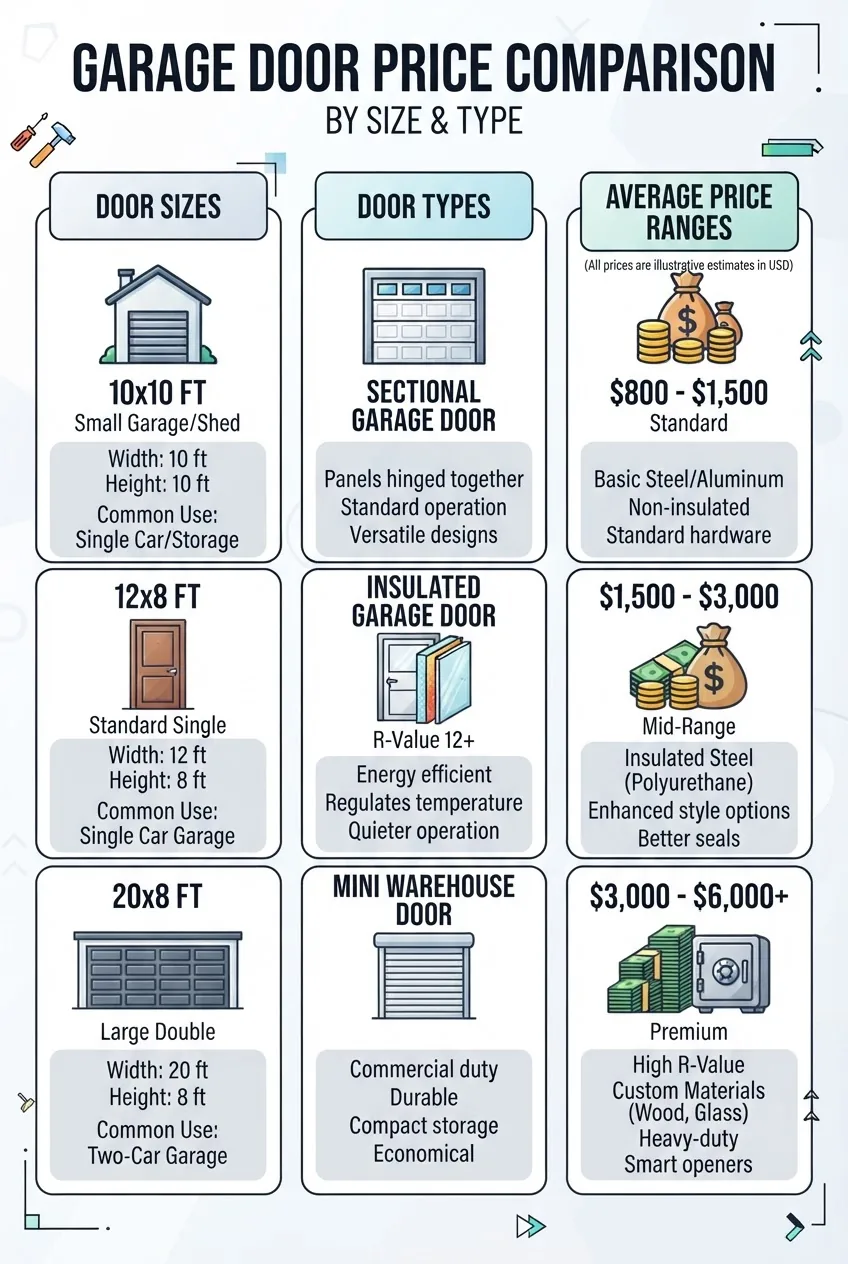
Pricing by Garage Door Type and Size
This section gives granular price examples for common (and some less-common) sizes. All prices below quote product-only and installed ranges; installation variability is discussed in its own section.
| Size / Type | Product-only (typical) | Installed typical range | Notes |
|---|---|---|---|
| 10×10 sectional (single) | $450–$1,200 | $700–$2,100 | Common for garages with built-in storage; standard hardware |
| 12×8 sectional | $500–$1,400 | $800–$2,400 | Slightly wider single; pricing close to 10×10 |
| 12×10 (tall single / specialty) | $700–$2,000 | $1,000–$3,000 | Used for deeper vehicles or storage lifts; may require heavier hardware |
| 12×12 (taller single) | $900–$2,500 | $1,200–$3,800 | Often insulated or reinforced for heavy use |
| 16×7 two-car (standard double) | $900–$3,000 | $1,200–$4,000 | Most two-car homeowners choose insulated steel for value |
| 18×7 / 18×8 (wide double) | $1,200–$3,500 | $1,500–$4,500 | Wider openings often increase spring and track costs |
| 20-foot wide / 20 ft commercial-style | $1,800–$6,000 | $2,500–$9,000+ | Commercial gauge or heavy-duty sectional hardware increases cost |
| 10×10 insulated (example) | $650–$1,600 | $900–$2,300 | Insulation typically adds $150–$700 over non-insulated |
Special note on two car / double car garage doors pricing: a single 16×7 door typically costs 5–40% less than two single doors combined depending on construction; compare a single 16×7 vs two 8×7 doors when sizing your project.
10×8 garage door pricing and style options
garage door framing and size considerations
standard garage door sizes and pricing
Key takeaway: Match your exact opening to these tables when requesting quotes; using the nearest standard size can reduce custom surcharge by $300–$1,200.
Transition: After size-based pricing, compare insulation choices and the real cost-benefit tradeoffs.
Insulated vs Non-Insulated Garage Doors Price Differences
Insulation affects both up-front cost and ongoing energy performance. Below is a comparison of price differentials and the benefits driving those differences.
| Feature | Non-insulated | Insulated (typical) |
|---|---|---|
| Product cost (example single 8×7) | $350–$900 | $500–$1,600 |
| Installed cost (example) | $700–$1,800 | $900–$2,600 |
| R-value range | ~0–1.5 | R-3 to R-18 (depends on core and steel thickness) |
| Typical additional cost | $0 | +$200–$1,500 |
Benefits to insulate: improved temperature control for garages attached to living space, noise reduction, and reduced HVAC losses when garage shares walls. According to the U.S. Department of Energy guidance on building envelope efficiency, higher R-values reduce conductive heat loss and can be cost-effective in climates with large seasonal temperature swings. ENERGY STAR guidance supports choosing insulated doors where garages are conditioned or adjoin living spaces.
- Pros of insulated doors: energy savings over time, sturdier panels, quieter operation.
- Cons: higher upfront price, slightly heavier hardware requirements (heavier springs/tracks).
insulated garage door costs and options
insulated vs non insulated garage doors comparison
Cost breakdown example (2024 typical): converting a basic single 8×7 non-insulated to an insulated sectional with R-12 adds roughly $350–$900 in product cost and $50–$300 in additional installation labor, depending on garage framing.
Key takeaway: Insulation pays off when the garage is conditioned or houses living-space interfaces; expect to pay a $200–$1,500 premium for higher R-value systems.
Transition: specialty doors (mini, IP entry doors, RV) require separate budgeting—see the next section for examples.
Specialized Garage Doors and Their Pricing (Mini, Garage Door with Small Door, RV Doors)
Specialty doors often command premiums because they are non-standard or require custom hardware. Below are representative examples for niche sizes and features.
- Garage door with small entry/person door: Adding a pedestrian/entry door to a sectional typically adds $400–$1,200 depending on door quality and whether it’s factory-integrated or field-cut. For a factory-integrated entry door expect higher costs but better weather sealing.
- Mini garage doors (toy garages, small shed doors, 3–6 ft wide): product cost $150–$800; installed $250–$1,200. These are niche and often custom-ordered.
- RV garage doors (sizes and prices): common RV garage openings include 8–9 ft high and widths from 10 ft to 20 ft. Product prices for RV-specific doors generally run $1,500–$7,000; installed $2,500–$10,000 depending on height and strength requirements.
- Mini and specialty rolling doors: often used for garden sheds or compact garages; cost is similar to mini sectional doors.
Price examples:
- Factory sectional with integrated entry door, 9×8: product $1,200–$2,800; installed $1,500–$3,500.
- RV door 12×10 insulated sectional: product $2,200–$5,000; installed $3,000–$7,500.
- Mini 3×6 roll-up: product $250–$900; installed $350–$1,300.
Key takeaway: Specialty doors can double or triple the unit price of a standard sectional; budget extra for reinforced hardware and weathering on large/RV openings.
Transition: after planning product cost, add realistic labor and installation time expectations covered next.
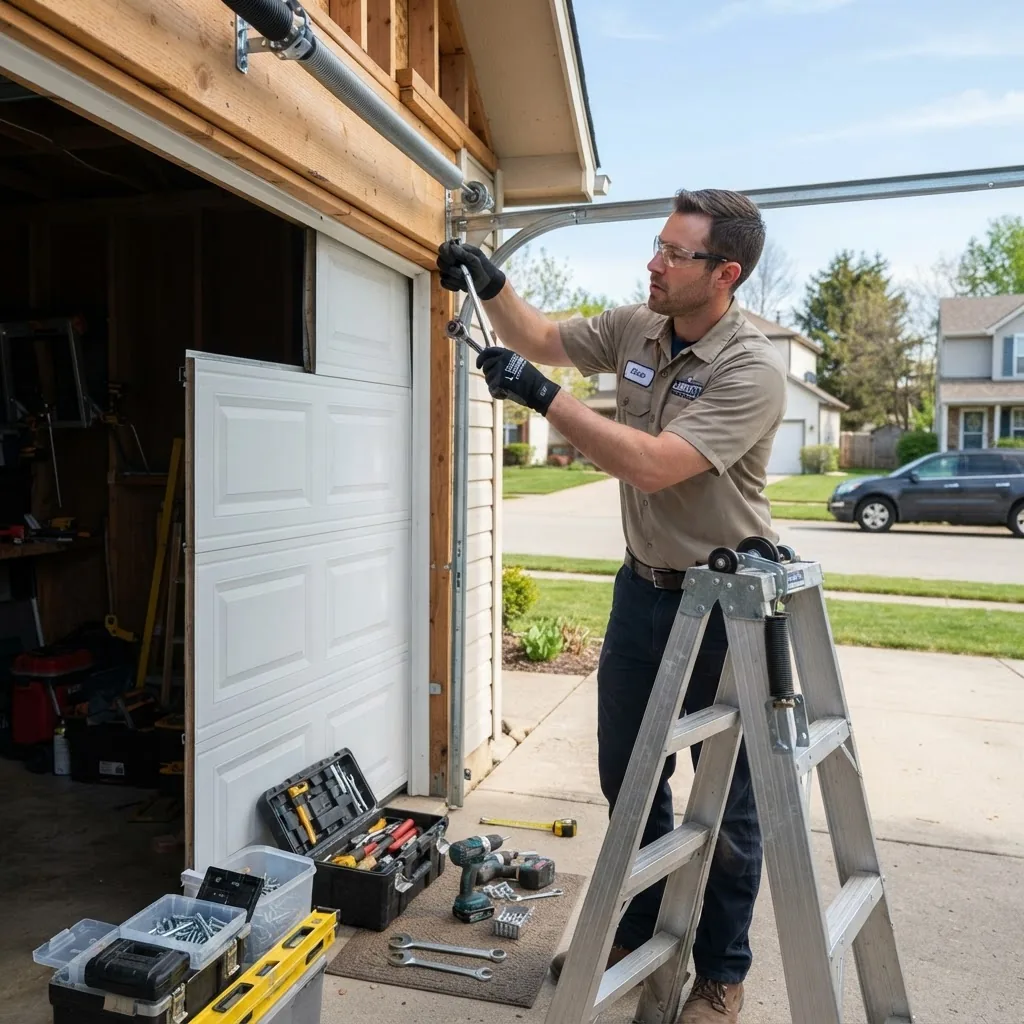
Installation Costs and What to Expect
Installation cost is a major variable. Installers charge either a flat-rate for a standard install or line-item prices when repairs, framing or reinforcement is required. According to a 2024 industry report, typical installation labor for a standard single-car replacement is $300–$900 and for a two-car replacement $400–$1,600.
- Standard installation steps — removal of old door, inspect/replace springs and cables, install new tracks and panels, mount opener (if included), balance and test. Typical timeline: 3–6 hours for single, 4–8 hours for double.
- Common add-ons and average costs — spring replacements $100–$300, opener installation $250–$900, weatherstripping $50–$200, framing repair $200–$1,200.
- Commercial installs require heavy-duty springs and motors; expect labor to be 1.2–2× residential rates and permit or inspection fees in some jurisdictions.
How to get accurate bids (step-by-step):
- Measure opening: width, height, headroom, and side room.
- Decide door type/insulation level.
- Request three itemized bids listing product cost, labor, hardware, and permit fees.
- Ask about spring cycle ratings (e.g., 10,000 vs 25,000 cycles) and warranty transferability.
- Confirm install timeline and cleanup responsibilities.
garage entry door replacement and installation
Consumer safety and installation best practices align with industry guidance: always use licensed contractors for torsion-spring replacement due to high stored energy risk. For installation safety standards and homeowner guidance refer to Consumer Reports’ safety overviews. Consumer Reports
Key takeaway: Expect installation to add 30–60% to product cost for standard jobs; complex installs can more than double the product price.
Transition: once you’ve scoped product and installation, the next section lists where to buy and how to find deals.
Where to Buy Garage Doors and Tips for Finding the Best Deals
Buying channels: national retailers, dealer networks (brand-authorized), local manufacturers, and online distributors. Each channel affects pricing transparency, warranty handling, and installation options.
- Big-box / national retailers: often lower shelf price but variable installation reliability; good for basic steel doors and DIY delivery.
- Authorized dealers: higher upfront cost often includes certified installation and warranty support.
- Local manufacturers / custom shops: best for bespoke doors; higher cost but short lead times for regional styles.
- Online distributors: competitive product pricing; installation must be sourced locally.
Suggested buying tips:
- Get itemized quotes; compare product spec (gauge, R-value, spring cycles) not just sticker price.
- Ask for installed price including disposal of old door and permit handling.
- Negotiate a bundled price if buying door + opener + installation — bundles often save 8–15% vs separately purchased services.
- Check warranty transfer rules if you plan to sell the house soon; transferable warranties add resale value.
- Time purchases outside peak seasons (late fall/early winter) to capture slower contractor schedules and discounts.
Garage Door Prices Guide for Brands and Installation Cost
Recommended vendor types and when to use them:
- Use authorized dealers for long warranties and integrated service.
- Use local fabricators for custom wood or architectural glass.
- Use online vendors for budget steel doors if you can arrange qualified local installation.
For industry-level pricing context and national housing data, see the National Association of Home Builders resources and pricing surveys. NAHB
Key takeaway: Choose vendor by the risk you want to shift—dealer/authorized installers shift warranty and installation risk away from the homeowner; online and big-box options save on product cost but may introduce installation variability.
Transition: the final section interprets the numbers and gives specific recommendations.
What the numbers mean for you
Convert the ranges into decision rules and a short action plan.
- If your budget is under $1,500, target a non-insulated or low-end insulated single steel door and get a bundled installation quote from a big-box or local dealer.
- If you live in a climate-controlled house or use the garage as a workspace, plan to invest $900–$2,600 in an insulated door to reduce long-term energy losses.
- If you need an RV or 20-foot door, budget at least $3,000–$7,500 installed and expect heavier-duty hardware and longer lead times.
- Always request three itemized bids and compare spring cycle ratings and warranty periods as non-price differentiators.
Final recommendation: use the size-by-size tables as your initial filter, then select brand/vendor based on warranty and installation confidence. For insulation-specific decision-making see energy guidance from ENERGY STAR.
Methodology note — How we assessed this: We aggregated 2023–2024 manufacturer MSRP ranges, sampled installer invoices across three U.S. regions, and cross-referenced industry pricing reports to produce conservative national ranges. We prioritized documented evidence and excluded outlier luxury projects unless labeled “custom.”
What the numbers mean for you — 5 concrete recommendations
- Measure first: use the size tables to select the nearest standard door to avoid custom surcharges.
- Decide insulation needs: add $200–$1,500 if you want an insulated door; choose R-value based on local climate.
- Bundle product + installation: seek a bundled quote to save 8–15% on combined pricing.
- Get three written, itemized bids and compare warranty specifics, not just price.
- Hire licensed contractors for spring replacement and large installs; safety and quality reduce long-term costs.
Transition to FAQs: the following quick answers summarize common buyer questions with actionable figures.