
In today’s fast-paced and ever-evolving work environments, ensuring workplace safety is more important than ever. Fire emergencies can arise unexpectedly, and having trained individuals who know how to respond quickly and effectively can make a critical difference. This is where online fire warden training steps in offering a modern, flexible approach to gaining essential safety skills without disrupting busy schedules.
Designed to fit around professional and personal commitments, online fire warden training empowers employees, managers, and safety officers to learn at their own pace while still meeting compliance requirements. Through interactive modules, real-world scenarios, and up-to-date safety guidelines, learners gain the knowledge and confidence needed to prevent fire risks, lead evacuations, and protect lives.
As organizations increasingly embrace digital learning solutions, online fire warden training has become a practical and accessible way to build a safer workplace. In this article, we’ll explore how flexible learning can equip individuals with the critical skills required to respond effectively in emergency situations.
The Fire Warden’s Role: Responsibilities, legal requirements, and where online learning fits
Core duties of a fire warden and evacuation warden
A fire warden is the designated lead for fire safety on a floor or within a zone, coordinating emergency procedures that protect people and property. As an evacuation warden, the role expands to pre-incident planning, route checks, and guiding occupants during an emergency evacuation. Day to day, a fire warden inspects exits, verifies fire alarm pull-station access, monitors housekeeping for hazard prevention, and ensures that vulnerable occupants have assistance plans. During incidents, the evacuation warden initiates local response, communicates with incident command, sweeps assigned areas, and reports head counts at assembly points.
Online fire warden training equips wardens to execute these responsibilities consistently across shifts and sites. Through online training, virtual training, and strategically scheduled in-person training, wardens build confidence in emergency procedures, evacuation leadership, and post-incident reporting.
Legal frameworks, safety standards, and organizational accountability
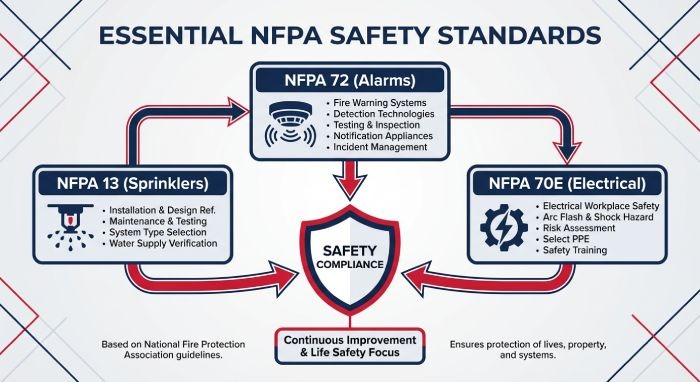
Organizations are obligated to maintain building safety and life safety programs aligned with safety standards issued by the National Fire Protection Association (NFPA) and local codes. While jurisdictions vary, references such as NFPA 72 (fire alarm systems), NFPA 13 (sprinkler systems), and NFPA 70E (electrical safety in the workplace) inform best practice. UW Environmental Health & Safety and the University of Washington, Environmental Health & Safety (UW EHS) illustrate how institutions set policy, publish procedures, and offer Emergency Evacuation Warden Training Online as part of Building and Life Safety Training. Online fire warden training maps these requirements to practical, site-specific tasks, ensuring a defensible program with trained evacuation warden teams.
What the Curriculum Covers: Hazard recognition, evacuation leadership, communication, and extinguisher awareness
Hazard recognition and prevention across occupancies
Comprehensive training programs develop a warden’s ability to spot risks before they escalate. Core topics include:
- Combustible loading, egress obstruction, and electrical safety deficiencies.
- Fire protection systems fundamentals how sprinkler systems, standpipes, and fire alarm notification work together.
- Housekeeping for hazard prevention in health care buildings, commercial buildings, and construction sites.
- Building and life safety code orientation
Building and Life Safety Training places the fire warden’s daily inspections in the context of means of egress, door hardware, illuminated exit signage, and rated enclosures. Wardens learn how emergency procedures should reflect occupancy type, occupant load, and special hazards.
- Fire protection systems essentials
Fire Protection Systems Training explains how NFPA 13 governs sprinkler systems design and how NFPA 72 standardizes fire alarm detection, initiation, and notification. Sprinkler Systems Online Training helps evacuation warden teams understand when water supply, valves, or impairments must be escalated.
- Electrical risk awareness
Electrical Training referencing NFPA 70E reinforces approach boundaries, labeling, and lockout/tagout interfaces that affect fire safety. While wardens don’t perform energized work, they must identify unsafe conditions and escalate promptly.
Evacuation leadership, communication, and portable extinguishers
Evacuation leadership modules walk through decision-making, including when to shelter in place, horizontal movement in health care buildings, and relocation routes in high-rises. Communication skills focus on clear, concise instructions under stress and coordination with security, facilities, and responding agencies.
- Incident response communication protocols
Wardens practice radio discipline, hand signals for noisy construction sites, and redundancy when public-address systems fail. Content also covers basic extinguisher awareness PASS technique, limitations by class of fire, and when evacuation takes precedence.
Flexibility and Engagement Online: Self-paced modules, microlearning, simulations, and mobile accessibility
Self-paced design that fits shift work and remote teams
Modern online fire warden training leverages self-guided modules and microlearning to fit around operational realities. Short, scenario-based videos, knowledge checks, and quick-reference job aids empower wardens to revisit critical emergency procedures before a drill. Asynchronous learning supports distributed teams, while learning paths allow supervisors to assign role-specific content. With mobile access, wardens can complete self-guided modules on a phone or tablet during downtime, and virtual libraries store SOPs, floor plans, and unit-specific checklists.
- Microlearning checklist for on-the-go mastery
- 5–7 minute refreshers on alarm tones and codes
- Map-based route confirmation for each evacuation warden
- One-page extinguisher selection guide
- Pre-drill “ready list” to validate headcount boards and radios
Live engagement with simulations and hands-on practice
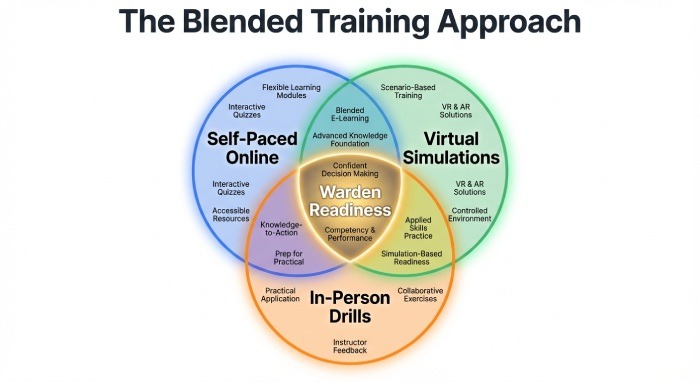
Online training does not exclude practice. Synchronous training via webinars and virtual training rooms enables expert instruction, role-play, and interactive exercises. Simulations model smoke migration, blocked exits, and elevator recalls, bridging to in-person training for tactile skills like extinguisher handling and stair-chair assist. Platforms that support networking with students foster peer learning, while digital badges can recognize completion of milestones in a blended workplace training plan.
Certification and Compliance: Assessments, accreditation, refresher intervals, and training records
Proving competence and staying audit-ready
Compliance thrives on evidence. Quality online fire warden training uses scenario-based assessments, practical drill participation, and documented competencies to award a certificate of completion. Many training options also issue CEUs or continuing education units; if your LMS denotes a CEU, confirm the hour-to-credit ratio and acceptance by your regulator. Although there is no specific NFPA certification for the fire warden role, alignment with NFPA guidance is crucial. Look for authorized training providers or programs within the NFPA Authorized Education Network to validate content accuracy.
Refresher intervals commonly run 12–24 months, with shorter cycles for high-risk occupancies. Online training simplifies renewals: self-guided modules can auto-assign updates on policy changes or new equipment, while virtual training sessions reinforce team coordination. A robust LMS logs attempts, scores, and expirations, attaches the certificate of completion to each profile, and can display digital badges for drill leadership or advanced modules. This recordkeeping supports audits, contractual obligations for training for organizations, and internal safety performance metrics.
To round out competencies, pair Emergency Evacuation Warden Training Online with specialized modules such as Fire Protection Systems Training, Electrical Training, and Sprinkler Systems Online Training. This blended approach builds confidence across incident response, system impairments, and post-incident recovery.
Selecting and Implementing a Program: Vetting providers, tailoring content to your site, and integrating with drills
How to evaluate and operationalize your training programs
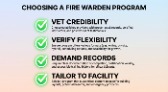
- Vet content credibility. Confirm alignment with the National Fire Protection Association, reference to NFPA 72, NFPA 13, and NFPA 70E, and applicability to your jurisdiction’s safety standards. University-based resources such as materials from UW Environmental Health & Safety can benchmark quality and clarity.
- Verify delivery flexibility. Ensure online fire warden training offers both asynchronous learning (for shift coverage) and synchronous training (for Q&A and tabletop exercises). The best online training pairs virtual training with scheduled in-person training to validate skills under realistic conditions.
- Insist on role-based learning paths. Assign self-guided modules to roles such as fire warden, deputy, and evacuation warden, plus supervisors. Provide microlearning refreshers before quarterly or semiannual drills.
- Demand robust assessments and records. Require scenario assessments, drill participation logs, and automatic issuance of a certificate of completion. Confirm that CEUs or continuing education units are documented when offered.
- Prioritize usability and access. Choose platforms with mobile access, multilingual captions, and virtual libraries for site plans and procedures. Integrate with existing workplace training systems and HR records.
- Tailor to your occupancies. Health care buildings may emphasize horizontal evacuation and defend-in-place strategies; commercial buildings focus on stairwell management and occupant accountability; construction sites require dynamic route checks and hot-work oversight. Training programs should adapt scenarios, floor-plan overlays, and communications tools accordingly.
- Ensure system literacy. Wardens should understand the basics of fire protection systems, sprinkler systems, and fire alarm interfaces, what to check daily, what to report, and how impairments affect emergency procedures.
- Pilot, then scale. Run a pilot with one facility or floor team, monitor completion, drill performance, and feedback, then roll out across sites. Use after-action reports to refine content and schedule blended in-person training for complex skills.
When comparing training options and authorized training providers, consider platforms like OnAlert that support enterprise rollouts, training for organizations with distributed teams, and administrative dashboards for compliance. Engage facilities, security, and Environmental Health & Safety stakeholders early so the program integrates with drills, alarm testing, and system maintenance windows. With the right mix of online fire warden training, virtual training touchpoints, and targeted in-person training, your evacuation warden team will be prepared to execute emergency procedures decisively and you’ll have the data, CEUs, and certificate of completion trail to prove it.