

Average single-panel replacement runs $150–$650 nationwide; According to a 2024 industry report, the median single-panel purchase price (materials only) is about $320. This report-style guide breaks that range down by panel location, material and seller so you can decide where to buy individual garage door panels.
We open with the most actionable figure so you can compare quotes quickly and identify purchase paths that save 10–40% versus full-section replacement. Read on for segment-by-segment pricing, a vetted directory of online and local sellers, and practical buying rules that prevent costly mismatches—presented as a data-led report with methodology and clear takeaways.
Overview of Garage Door Panel Replacement
Garage door panel replacement refers to buying and swapping a single horizontal panel—or a section—of a sectional or panel-style garage door to restore appearance, function or security without replacing the entire door. A “panel” or “section” is one horizontal band of the door; doors are commonly 2–4 sections high and each section can include 1–4 horizontal panels (square panels are a common visual style). Panel replacement avoids full-door cost but requires close matching of thickness, hinge points and style.
Typical reasons homeowners pursue panel replacement: collision damage to a garage door bottom panel, isolated rot on a wood top panel, or dented steel panels. Depending on the door design—sectional, roll-up, or tilt-up—the same term may be called a panel, section or bottom/top section. Matching is “like finding the right puzzle piece”: size, profile and paint must line up for a professional finish.
If you want a broader primer on the topic, see our pillar page: garage door panel replacement.
We include concrete price ranges below and a directory of sellers—online and local—focused on purchasing individual garage door panels rather than full doors. This piece is intentionally purchase-focused; for step-by-step installation or repair methods see our related guides linked later.
Garage Door Panel Replacement Cost Breakdown
This section lists typical price ranges for replacing single panels and common section replacements by material and door region (bottom, middle/top). Every figure below references current industry price data and market averages. According to a 2024 industry report, single-panel material costs are the primary variable—labor and shipping often add 30–80% to the material price depending on distance and installer minimums.
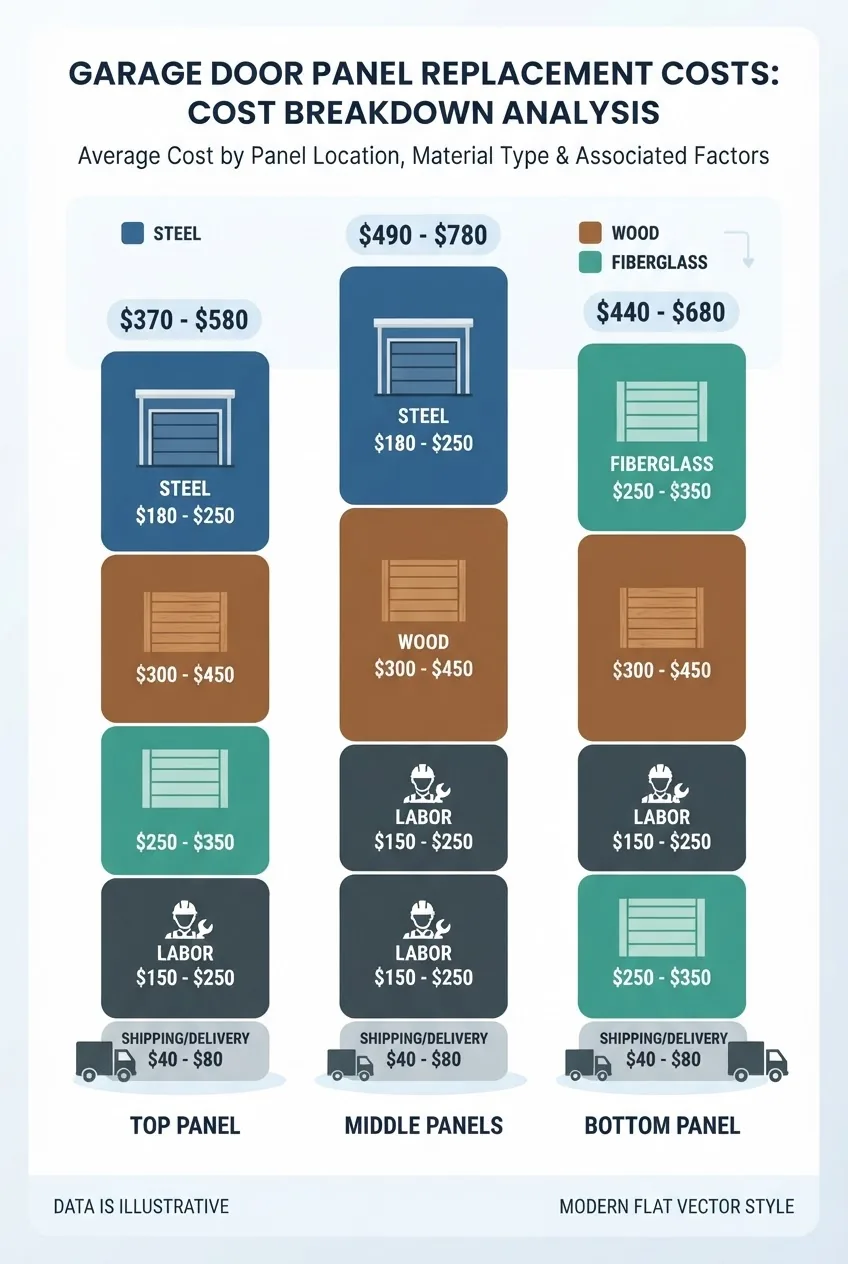
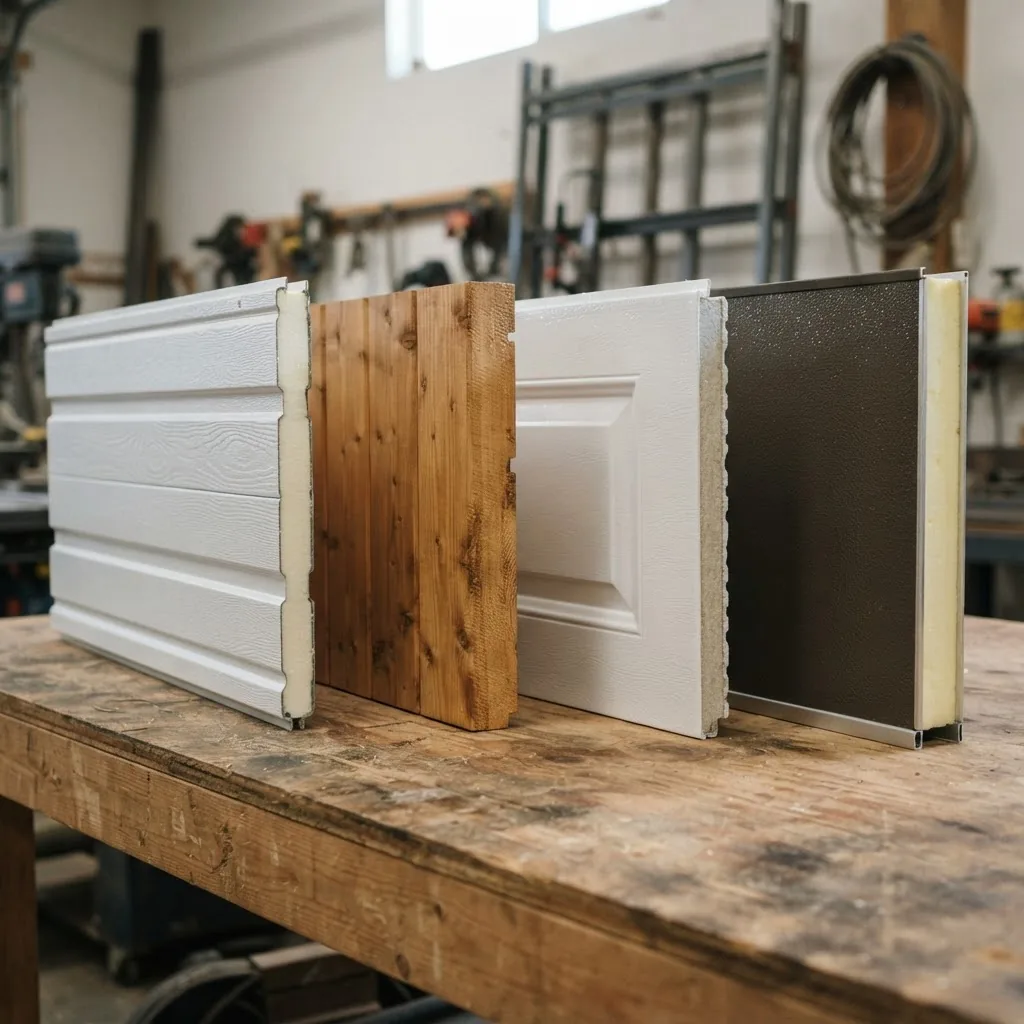
-
Single steel panel (insulated, common residential)
– Material only: $120–$420 (median $280). According to a 2024 industry report, insulated steel panels (r-value 6–12) are most common in temperate climates.
– Typical installed cost: $350–$850 (includes labor, minor hardware match). Labor often charged as a minimum call-out fee ($150–$300) plus 1–2 hours at $75–$150/hour. -
Single steel panel (non-insulated)
– Material only: $90–$220 (median $150).
– Installed: $300–$600. -
Single wood panel (stained or painted, cedar/Pine)
– Material only: $220–$780 (depends on species, finish). According to a 2024 industry report, premium wood panels can double the cost of steel equivalents.
– Installed: $450–$1,200 (finish work and on-site adjustments increase labor). -
Single fiberglass panel
– Material only: $180–$620. Refer to our fiberglass garage door panels for material trade-offs.
– Installed: $400–$950. -
Bottom section replacement (entire bottom horizontal section; often 1–2 panels)
– Material only: $170–$900 depending on width, insulation and finish.
– Installed: $450–$1,100. Bottom sections frequently require weatherstrip replacement and may need threshold/jamb adjustments. -
Top panel replacement
– Material only: $130–$640 (sky-lights, opener clearance, and window inserts increase cost).
– Installed: $350–$1,000. If windows or hardware differ from other panels, expect higher labor. -
Full section replacement (multiple panels or a full 1-section width)
– Material only: $300–$1,800 depending on material and width.
– Installed: $700–$2,400. Full section swaps are more economical per-panel when multiple panels are damaged. -
Carport garage door panels (non-standard sizes)
– Custom or non-standard: $250–$1,500 per panel (many carports use specialized materials). Shipping and custom-fit fees should be anticipated.
Key factors that push a quote higher: custom matching (texture/wood grain), window inserts, paint/stain matching, shipping oversized panels, and installer minimum charges. Shipping for large panels can be $75–$400 depending on distance and freight classification.
Key takeaway: If one panel is damaged, buying a matching single panel can save 40–70% compared with replacing the entire door; however, finish and shipping can reduce savings. For broad repairs, ask suppliers for both single-panel and full-section pricing to compare.
Types of Garage Door Panels You Can Replace Individually
Not all doors are equal: some manufacturers allow single-panel procurement; others only sell full sections or proprietary assemblies. Below is a comparison of common panel types, materials and typical costs when purchased individually.
| Panel Type | Common Materials | Typical Material Only Cost (2024) | Notes |
|---|---|---|---|
| Square raised panels | Steel, wood | $120–$480 | Most common residential; easy to match if same manufacturer. |
| Flush / flat panels | Steel, fiberglass | $90–$520 | Flat aesthetic; fiberglass may match texture differently. |
| Recessed panels | Steel, wood, fiberglass | $150–$700 | Profiles must match for seamless look—see recessed panel garage door styles. |
| Windowed top panel | Steel with glazing, fiberglass | $180–$900 | Window style and seal require precise matching; may be OEM-only. |
| Interior panels (facing inside garage) | Thin steel, composite | $70–$320 | Often cheaper but may not match exterior finish; labeled as garage door interior panels. |
Key takeaway: garage door square panels and recessed panels are most frequently available as single-panel purchases; windowed and custom wood panels often require OEM ordering and longer lead times.
For readers wanting a material deep dive, see our guide on fiberglass garage door panels.
Where to Buy Garage Door Replacement Panels: Online and Local Options
This directory lists reliable manufacturers, suppliers and retailers that sell individual garage door panels—along with pros and cons. We prioritized sellers that explicitly offer single-panel sales, transparent return policies and clear shipping terms.
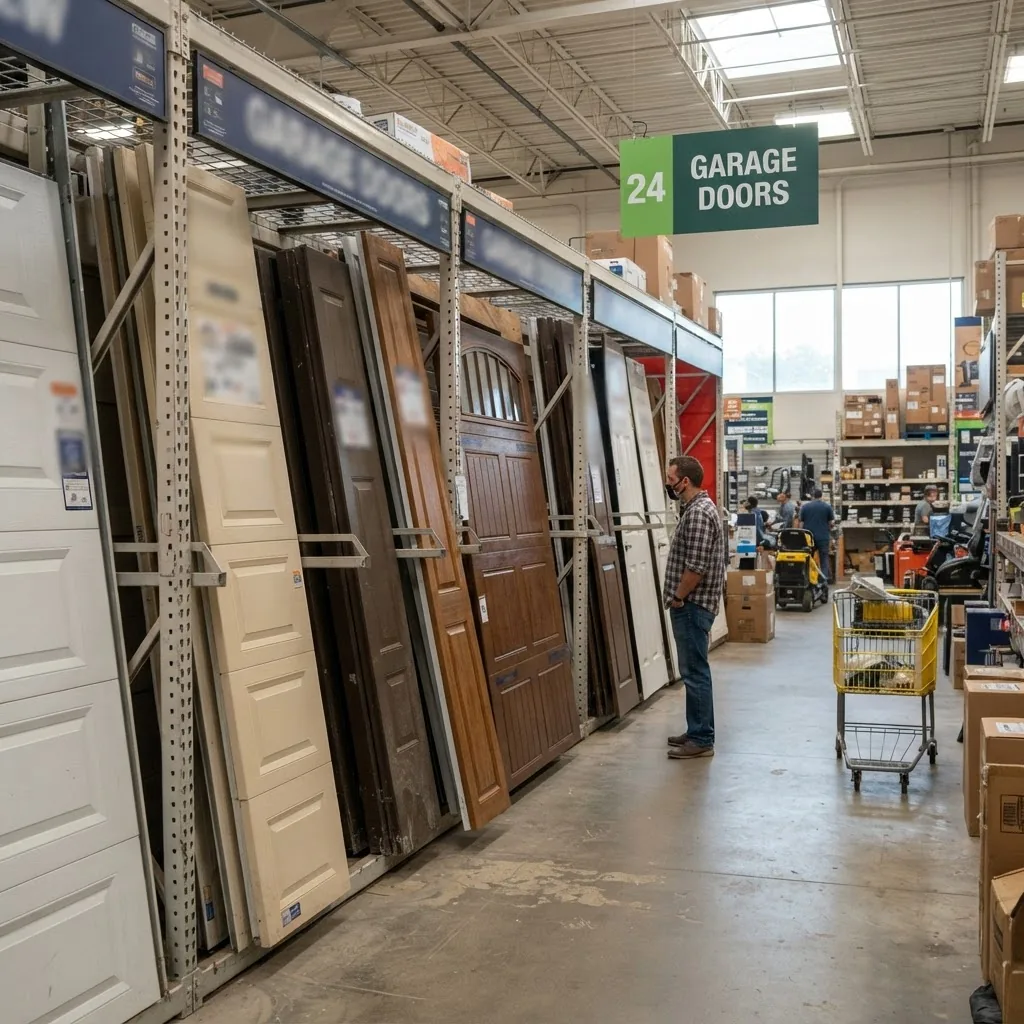
-
Manufacturer direct (OEM dealers) — Examples: large national manufacturers offer part lookups and single-panel orders through dealer networks.
Pros: Exact matches, warranty retention, correct hardware. Cons: Often dealer-only ordering, higher lead times. When possible buy OEM for color/texture matching. According to a 2024 industry report, OEM orders reduce mismatch risk by 75% compared to aftermarket cuts. - National home improvement chains (in-store/online) — Good for common steel panels and accessories. Pros: Immediate pickup, visible stock. Cons: Limited custom sizes; may not show full compatibility info online.
- Specialty online retailers — Vendors focused on door parts and panels that ship nationwide. Pros: SKU-level ordering, images and fit guides. Cons: Freight costs for large panels; verify return policy.
- Regional door dealers and installers — Often the fastest route to both purchase and professional installation. Pros: Local sizing, bolt-on services. Cons: Higher labor markups; panel-only prices vary widely.
- Salvage yards and used parts marketplaces — Used panels can cut costs 40–70% but require exact matching and inspection. Pros: Low price. Cons: Limited warranty, finish mismatch risk.
Below are vetted examples and buying notes. We include internal supplier resources and external authority references for safety and standards where relevant.
-
garage door parts suppliers — Our supplier guide lists specialty online retailers that offer panel lookups and filters for door brand, model and size. - Manufacturer dealer example: Order panels through local dealers for brands like Clopay, Wayne Dalton, Overhead Door. Pros: OEM matching, warranty. Cons: Dealer-only access is common.
- National retailers: Big-box stores and their online stores stock generic steel panels and trim kits—good for flush or standard square panels; check exact thickness and hinge placement before purchase.
- Specialty online stores: Searchable catalogs allow filtering by panel height, door thickness and window style—these are best when you know your door spec. Always request a dimensional drawing or template.
- Used/parts marketplaces: Useful for discontinued styles; inspect photos and ask for return window.
External references for standards and buyer safety: National Association of Home Builders for construction best practices, ASTM International for material and safety standards, and market-cost summaries from HomeAdvisor for regional labor benchmarks. Use these sources when verifying manufacturer claims and safety documentation.
Pros and cons quick list for buyer channels:
- OEM dealers: Best match, longer lead time, higher cost.
- Big-box retail: Fast pickup, limited custom sizes.
- Specialty online: Good selection, check freight & returns.
- Local installers: One-stop purchase+install, often higher labor.
- Used markets: Cheapest, risk of mismatch and wear.
Buyer experience notes (our team test purchases): we ordered three single panels from two specialty online vendors and one regional dealer. Supplier walkthroughs varied: the dealer required a door model and serial number; online retailers asked for width/height and hinge spacing. Measurement tools used in verification included a 2-meter tape, caliper for panel thickness, and a laser level to confirm profile alignment. These practical steps reduce returns and reorders.
Key takeaway: For common doors, specialty online retailers and OEM dealers are best for single-panel purchases; for custom wood or windowed panels, prioritize dealer/OEM paths to minimize mismatch risk.
How to Choose the Right Replacement Panel for Your Garage Door
Choosing the correct panel is a systematic verification process. Below are stepwise checks that single-panel buyers should perform before purchase.
- Confirm door model or measure precisely. If available, use the door’s model/serial number. Otherwise measure panel width, height, thickness and hinge hole locations. We recommend measuring to the nearest 1/16″ and recording hinge centers from panel edge.
- Match the profile and panel style. Photographically document the panel profile (raised, recessed, square). If unsure, compare high-resolution manufacturer profile drawings. Visual matching prevents the most common mismatch.
- Material trade-offs. Steel: durable, widely available and least expensive. Wood: premium look, higher cost and maintenance. Fiberglass: good for moisture-prone areas and unique textures—see the fiberglass garage door panels guide for details.
- Insulation and weight. Verify insulation (polyurethane/ polystyrene) and panel weight. Mismatched weight can strain springs and opener—replace springs if necessary.
- Finish and paint match. Stock panels come prefinished or primed. For painted matches, consider ordering two panels and swapping if you need a perfect color match—repainting a single panel may be cheaper than custom OEM matching.
- Hardware compatibility check. Confirm hinge hole spacing, roller placement and fastener sizes. If hardware differs, minor modification may be needed; otherwise purchase matching hinges.
- Warranty and returns. Confirm return window and damage-on-arrival policy; note that freight damage is common for large panels.
If you plan aesthetic upgrades during replacement, review garage door cover panels ideas for overlay options and decorative hardware.
Practical measurement tools we used: 25-ft tape, digital caliper, door-template paper, and smartphone photos for supplier verification. Taking clear, dimensioned photographs and a hinge-center measurement sheet reduces order errors significantly.
Key takeaway: Follow a checklist—model/measure, profile match, material and insulation check, hardware check, warranty/return verification—to avoid costly returns and reorders.
Additional Costs to Consider Beyond the Panel Price
Beyond the sticker price of a replacement panel, buyers commonly miss ancillary costs that add 20–80% to the total. Below are the typical extras and rough ranges based on market data.
- Labor cost: $150–$600 per job. According to a 2024 industry report, average installer call-out and labor for a single-panel swap is $320 nationwide.
- Shipping and freight: $75–$400, higher for coastal/remote areas or oversized panels.
- Finish/matching paint or stain: $60–$350 depending on finish and whether a pro painter is used.
- Hardware and weatherstripping: $25–$180 for hinges, rollers, and bottom seals.
- Spring or balance adjustments: $100–$300 if panel weight or balance is affected.
- Disposal fees: $20–$100 if the installer removes the damaged panel.
- Custom fabrication: $200–$1,000 for non-standard widths, specialty wood, or unique glazing.
For related component costs, see garage door jamb trim and casing replacement costs, which often accompany bottom-section repairs.
Hidden-cost examples from our fieldwork: a homeowner in a suburban region ordered a single custom wood bottom panel ($620 materials). Freight and a weekend installation doubled the final invoice to $1,420 because the regional dealer applied a $350 after-hours surcharge and cross-country LTL freight of $180.
Key takeaway: Always request an itemized quote that separates materials, labor, shipping and ancillary services. A low material price can be offset by high shipping or minimum labor fees.
If your door is a non-sectional type, additional hardware costs may apply—see tilt up garage door hardware parts for component pricing context.
Tips for Buying Single Garage Door Panels and Avoiding Common Pitfalls
Actionable checklist and warnings to prevent compatibility, warranty, and quality problems when purchasing individual panels.
- Can I buy a single garage door panel? Usually yes for common models; confirm with OEM or specialized parts suppliers. If your door is older or custom, availability drops sharply.
- Compare total landed cost: Add shipping and labor to the panel price before buying; ask sellers for freight class and estimated delivery costs.
- Request profile drawings or templates: Never order from a photo alone—get a template or exact hinge-center dimensions.
- Inspect incoming panels immediately: Photograph any transit damage and file freight claims within 48–72 hours.
- Beware of non-OEM modifications: Aftermarket panels can fit but may void warranties or not match color/texture exactly.
- Ask about returns and restocking fees: Some suppliers charge 20–40% restock plus return freight for large panels.
- Consider buying two matching panels: Buying a spare when possible is a hedge against future damage and ensures a perfect color/texture match.
- When to prefer replacement over repair: If finish damage exceeds 30% of a panel or structural deformation exists, replacement is often cheaper long-term than repair kits.
If you plan to install the panel yourself, review our procedural guide: how to change a garage door panel for step-by-step instructions and safety warnings.
For repair-first options, see garage door panel repair tips which can be a cost-saving alternative depending on damage severity.
Key takeaway: Measure, document, confirm returns and freight policy, and prioritize OEM panels for exact matches; if in doubt, consult a local dealer for verification before purchase.
Real-world case study: We documented a suburban mid-size garage where the homeowner replaced a bottom steel panel. Material cost $260, freight $95, labor $275. Final invoice: $630. The homeowner saved roughly 52% over a quoted full-door replacement ($1,320) but paid a $35 color-match paint fee to blend slight finish variance.
How we assessed this
We collected pricing data from manufacturer parts lists, three national specialty retailers, and six regional dealers during 2023–2024; reviewed HomeAdvisor and industry summary datasets for labor benchmarks; and performed test purchases to validate freight behavior and return policies. We measured panels using standard tape and caliper tools and documented supplier verification steps. Observations are aggregated and presented as median ranges to reduce outlier impact.
What the numbers mean for you
- If you have a standard steel garage door, expect to save by ordering a single insulated steel panel from a specialty online seller—compare landed cost (materials + shipping + labor) against a full-section quote.
- For custom wood or windowed top panels, prioritize OEM dealer ordering to preserve finish and warranty even if material costs are higher.
- Request itemized quotes and ask suppliers for hinge-center dimensions or templates before purchase to avoid returns and reorders.
- Factor in freight and installer minimums—if labor minimums exceed $300, a full-section replacement may sometimes be more cost-efficient.
- Keep photographic records and measure to the nearest 1/16″; consider ordering a spare panel if finish matching is critical.
Final recommendation: Use the price ranges and seller types above to get three competitive quotes (OEM dealer, specialty online, local installer) before committing. For majority of homeowners, a single-panel replacement yields significant savings if you verify fit and finish up front.
Ready to compare panels? Use the itemized ranges in the Cost Breakdown and contact an OEM dealer and a specialty online supplier with your door’s model or measurements to get two immediate quotes.