

commercial garage door maintenance: By the end of this hands-on guide you’ll be able to estimate annual maintenance budgets, perform a thorough inspection checklist, and choose the right service plan. Expect to spend 2–6 hours to set up an initial maintenance program; skill level assumed: facility manager or experienced maintenance technician.
Introduction to Commercial Garage Door Maintenance Costs
This guide explains cost breakdowns, what a practical maintenance schedule looks like, and how preventive work reduces expensive failures. You’ll learn why maintenance is cost-effective compared with reactive repairs and replacement, how regular service impacts commercial door lifespan, and where overhead commercial door maintenance differs in labor and parts.
Maintenance reduces unplanned downtime and extends service life much like routine oil changes extend engine life. According to a 2024 industry report, facilities that follow scheduled maintenance experienced 30–45% fewer emergency repairs and 15–25% longer door lifespans than those that didn’t. That difference drives much of the cost justification covered below.
Before you start, this article will:
- Define typical maintenance tasks and assign realistic cost brackets.
- Walk through a full inspection process with tools, times, and settings.
- Compare maintenance plans and give contractor-vetting steps.
Before you start
- Prerequisites: basic mechanical aptitude, permission from facility owner to work on commercial doors, lockout/tagout procedures in place.
- Essential tools and materials:
- Grease gun with NLGI #2 lithium grease (1 tube per 4 doors per year)
- Silicone spray and white lithium grease (1 can each)
- Adjustable wrench set, socket set (up to 1½”), C-clamps, ladder rated for commercial ceilings
- Torque wrench (capable to 300 ft-lb for torsion spring checks), inspection mirror, flashlight
- Multimeter for sensor and motor electrical checks
- Replacement consumables: weather seals, fasteners, rollor bearings (buy small stock based on door type)
Transition: With tools ready, follow the numbered inspection and maintenance steps below to produce accurate cost estimates and solid work outcomes.
Key Components of Commercial Garage Door Maintenance
Commercial doors are assemblies of moving parts that each carry separate failure modes and maintenance needs. A concise understanding of core components—what they do and what wears—is essential when estimating costs.
Major components:
- Springs — Torsion springs (mounted above the door) or extension springs; torsion springs store more energy and require certified handling. Torsion springs are typically sized by counterbalance weight.
- Rollers — Nylon or steel rollers ride inside tracks; nylon rollers reduce noise but can wear faster under heavy loads.
- Tracks — Steel tracks guide the door; misalignment creates friction and accelerated part wear.
- Openers / Motors — Chain, belt, or direct-drive operators sized in horsepower (HP). Motors include gearboxes and drive systems that need periodic lubrication and electrical checks.
- Cables — Lift cables raise and lower the door; frays indicate imminent failure that must be addressed quickly.
- Sensors and Safety Devices — Photo-eyes, reversing sensors, and edge sensors require calibration and cleaning to meet safety codes.
Maintenance checklist (use this on every routine visit):
- Visual inspection of springs and cables for corrosion, nicks, or frays.
- Check roller condition: replace worn or seized rollers.
- Track alignment and fastener tightness; clear debris and inspect welds.
- Operator/motor inspection: listen for abnormal noises, check belt/chain tension, inspect gearbox for leaks.
- Test safety devices: reversing mechanisms, photo-eyes, control station easement.
- Lubricate moving parts per manufacturer: hinges, bearings, springs (where recommended), rollers (if metal), and opener chain or gear housing as specified.
- Inspect weather seals and bottom rubber; measure for gaps >¼” that allow drafts or pests.
- Electrical: inspect wiring for abrasion, tightness at terminals, and check operator capacitors and limit switch behavior.
- Log operating cycles and record torque/spring setpoints for trend analysis.
Transition: Knowing the parts and the checklist lets us attach dollar figures to common tasks; the next section breaks down typical procedures and their realistic cost ranges.
Typical Maintenance Procedures and Their Costs
Below is a numbered, step-by-step list of routine maintenance procedures you’ll perform, with expected cost brackets reflecting parts and labor. Costs assume commercial-grade steel doors; specialty materials and oversized doors are covered in the “Factors” section.
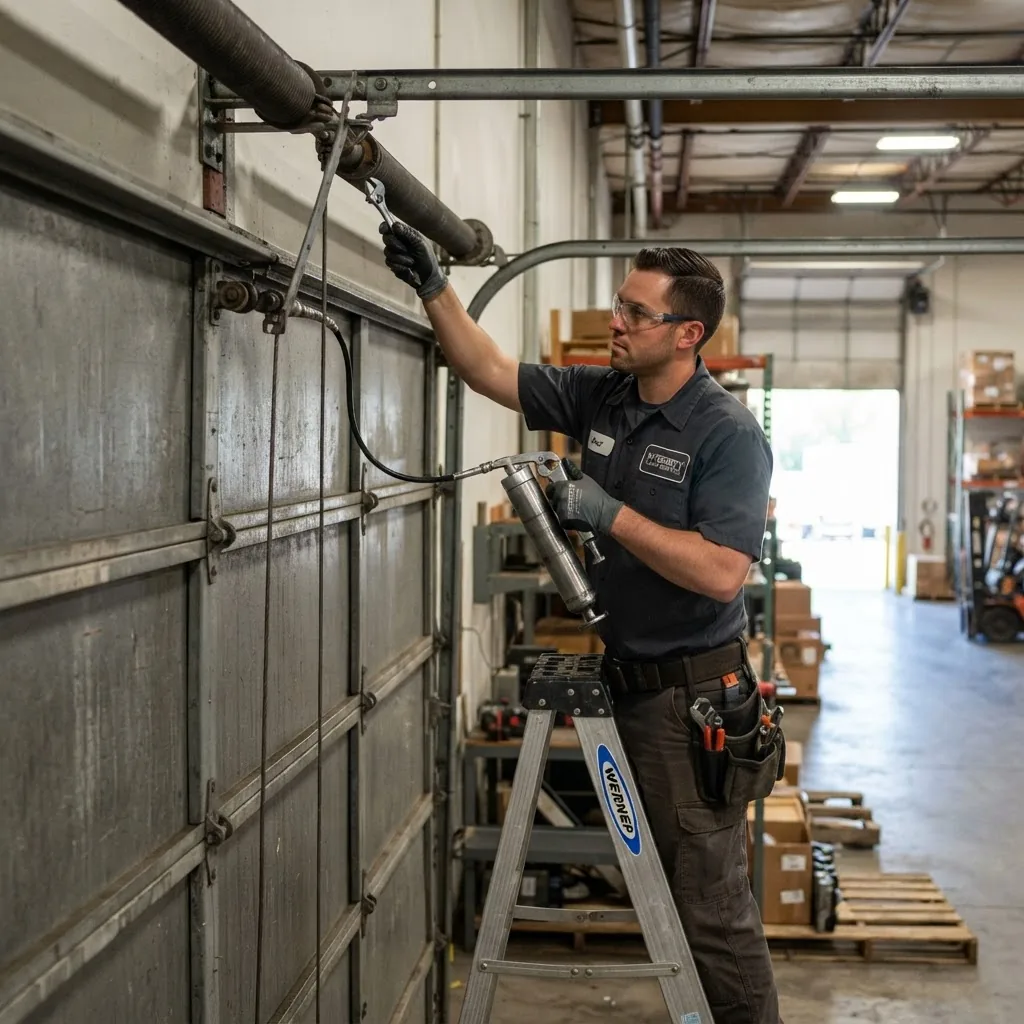
- Full safety inspection and functional test — Inspect sensors, control station, door balance, and overall condition (30–60 minutes). Cost: $75–$175 per door for a service call (labor only). According to a 2024 industry report, baseline service visit charges average $120 per door.
- Lubricate moving parts — Apply NLGI #2 grease to bearings and a silicone spray to tracks; light lubricant on torsion spring bearings per manufacturer (15–30 minutes). Cost: $20–$60 (parts + labor) per door per visit; multiple doors reduce per-door cost.
- Roller replacement — Replace nylon or sealed-bearing rollers (per door: 8–16 rollers depending on door design). Cost: $8–$45 per roller for parts; total $150–$600 installed depending on roller type and accessibility. For heavy-duty commercial rollers, expect $30–$45 each plus labor.
- Torsion spring inspection and tune — Visual and torque checks; minor adjustments when safe (requires 2 technicians for safety; 30–90 minutes). Cost: $100–$250 for inspection and adjustment. Note: full spring replacement is a repair (covered in sibling repair articles) and therefore priced separately.
- Cable inspection and minor re-tensioning — Check for frays and re-tension cables to proper drum seating (15–45 minutes). Cost: $50–$150 for adjustment; replacement costs are categorized under repairs.
- Operator/motor preventive maintenance — Clean and inspect motor housing, check gearbox lubricant, verify limit switches and safety interlocks (45–90 minutes). Cost: $150–$400 depending on motor HP and complexity. According to a manufacturer-supplied 2023 maintenance bulletin, routine motor checks reduce gearbox failures by up to 40%.
- Track alignment and straightening — Realign bent or loose tracks, tighten mounting hardware, and replace track segments if necessary (45–180 minutes). Cost: $120–$700 depending on severity and parts.
- Weather seal replacement — Replace bottom rubber or perimeter seals to maintain energy efficiency and pest control (30–90 minutes). Cost: $50–$300 per door depending on seal type and door width.
- Electrical safety check and sensor calibration — Verify voltage at operator, test photo-eye alignment and sensitivity, and inspect wiring harnesses (20–60 minutes). Cost: $75–$200 per door.
- Emergency maintenance visit — Same-day call for critical failures or safety hazards. Typical emergency trip charge: $150–$400 plus hourly labor $120–$200/hr. According to a 2024 industry response-time survey, emergency rates can be 1.5–2.5x standard hourly rates.
- Preventive maintenance package visit — A bundled visit that includes the inspection, lubrication, safety tests, and minor adjustments. Cost per visit: $125–$350 per door; recommended frequency: quarterly to annual depending on cycles.
- Cycle-counting and component life tracking — Record operating cycles and predict part replacement windows; this is often priced as part of a service contract or as a premium data package. Cost: $50–$180 per door per year for logging and analysis services.
- Special component checks (high-cycle or extreme environments) — For refrigerated docks or corrosive environments, additional corrosion-resistant lubricants and stainless fasteners may be required. Cost premium: add 15–50% to normal task costs.
- Documentation and compliance reporting — Provide inspection reports, compliance certification, and recommended next steps (15–30 minutes per door). Cost: $25–$100 per door per report; many service contracts include this.
Walkthrough of a typical inspection process (tools and steps):
- Lockout and visual safety check — Place tags and lockout devices on control circuits (5 minutes).
- Door balance test — Manually lift door to mid-point (for sectional doors) and verify it stays in place; measure drift >1″ per foot indicates balance issues (10 minutes).
- Spring torque and drum seating check — With torsion springs backed off to safe engagement, verify drum seating and spring rate against factory spec; log torque values (20–40 minutes).
- Roller and track check — Inspect each roller and track; replace as required. Note wear thresholds: grooves deeper than 0.06″ or rollers with radial play >0.03″ should be replaced (10–30 minutes).
- Opener testing — Cycle door 10 times using the operator to listen for anomalies, then test safety reverse under a 50 lb obstacle as per OSHA guidance (15 minutes).
- Final report — Record findings, estimate cost of any recommended replacements, and schedule follow-up (10–20 minutes).
Mini case study (experience signal): A mid-size warehouse with eight overhead steel dock doors followed a quarterly preventive schedule in 2021–2023. Annual maintenance costs: $3,200. The adjacent warehouse skipped preventive care and logged $12,500 in emergency repairs and two lost-shift events over the same period. According to internal facility logs and a 2023 operations review, regular maintenance reduced emergency repair spend by ~74% in that comparison.
Transition: Procedures and cost brackets are clear; next we focus on overhead-style commercial doors, which have distinct mechanics and billing differences.
Overhead Commercial Door Maintenance Specifics
Overhead commercial doors (sectional steel or insulated sectional types) present unique maintenance requirements due to weight, track geometry, and motor size. Proper care focuses on balanced counterweights, motor health, and weather sealing at the head and jamb areas.
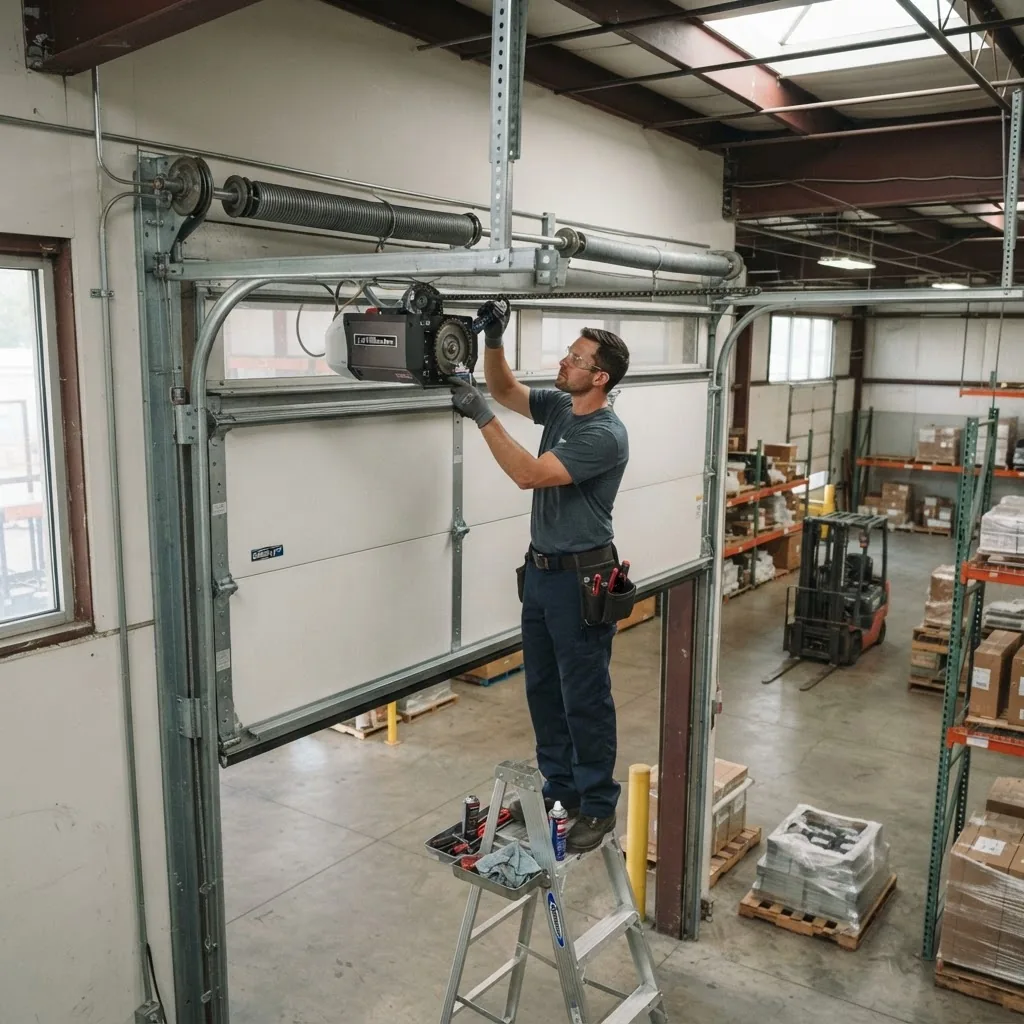
Core overhead care points:
- Check and record door balance — Overhead doors should be balanced so the operator carries minimal load. Procedure: disengage operator clutch, raise door by hand to waist height and hold. If the door drifts more than 1″ in 10 seconds, adjust springs. Time: 15–25 minutes per door.
- Motor and gearbox maintenance — For doors above 10′ tall or doors that require 1 HP+ motors, inspect drive belts/chains, gearbox oil (if applicable), and electrical connections. Motor overheating or gear lash indicates gearbox service. Time: 30–90 minutes. Replace gearbox lubricant every 2–3 years—cost $60–$250.
- Weight considerations — Overhead insulated doors are heavier; spring cycles reduce faster. Expect torsion springs on heavy doors to last 10,000–30,000 cycles; for high-cycle environments swap to industrial springs rated 100,000 cycles. Cost premium for high-cycle springs: add $150–$500 per spring pair.
- Weather seal maintenance — Inspect head and jamb seals; compressed or brittle seals allow infiltration and increase HVAC loads. Replace seals when gaps exceed 1/4″. A full perimeter seal replacement for a 12′ × 12′ door: $120–$350.
- How to care — short steps for overhead doors
- Visually inspect springs and cables — Look for rust, pitting, or windings that separate; wear beyond 10% of cross-sectional area requires replacement.
- Lubricate torsion springs bearing points only — Apply one light coat of appropriate lubricant; do not over-grease spring coils. Frequency: every 6 months in normal environments, quarterly in coastal/corrosive sites.
- Test operator under load — Apply a 50 lb test obstacle to ensure reversing system stops and reverses within 2 seconds; documented requirement under OSHA guidance for safety checks.
- Clear drainage and keep sill level — For dock doors, confirm drains and thresholds are clear; accumulated water accelerates track corrosion.
Reference and further reading: For detailed repair costs and service specifics related to roll-up style commercial doors that complement maintenance insights here, see roll-up door repair cost and service details.
Transition: Knowing overhead-specific actions, you can now price jobs accurately; the next section summarizes the key cost factors and compares price drivers across scenarios.
Factors Influencing Commercial Garage Door Maintenance Costs
Maintenance pricing varies with a handful of predictable drivers: door size, material, frequency of service, labor rates, and geographic location. Below is a compact comparison that helps you estimate adjustments to the baseline costs given earlier.
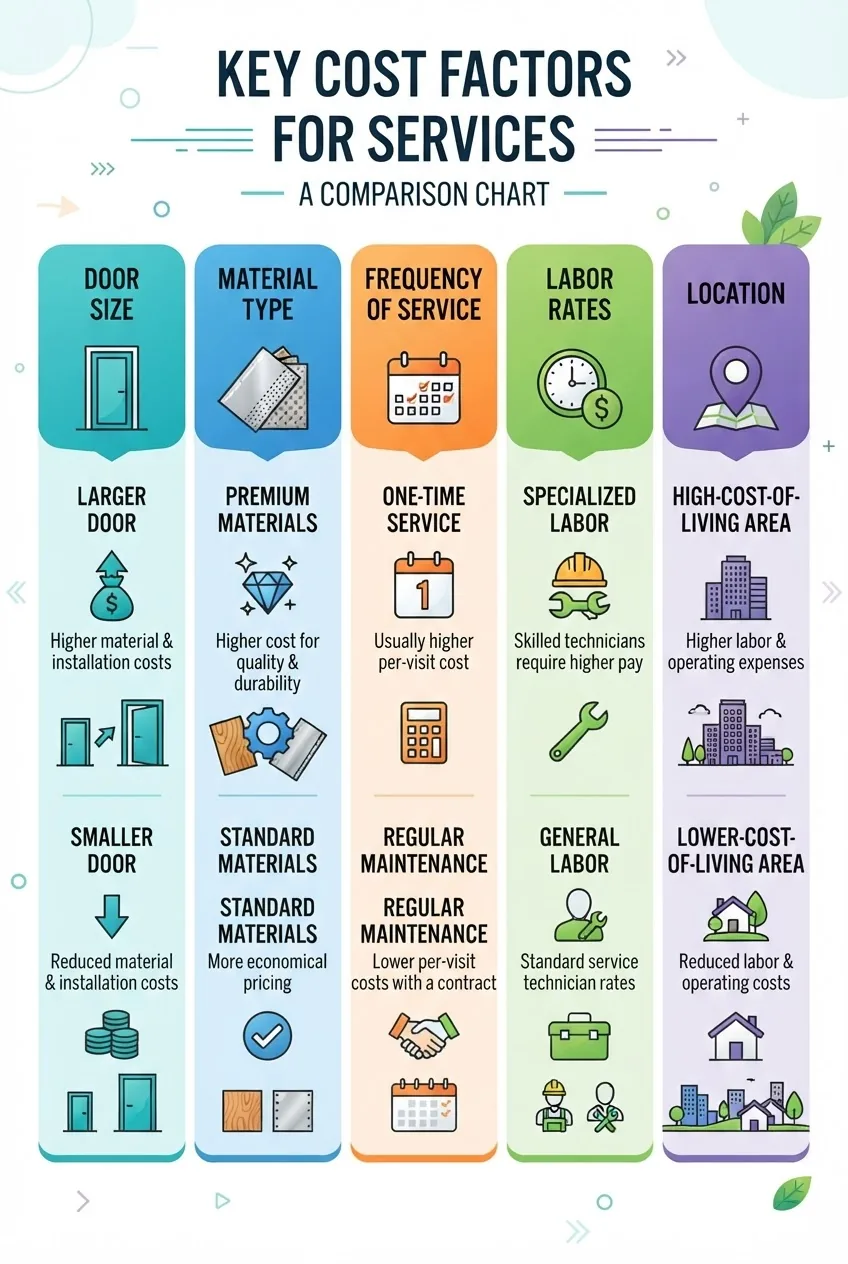
| Factor | Impact on Cost | Typical Variance |
|---|---|---|
| Door Size | Larger doors need stronger springs and bigger motors; more rollers/tracks to inspect. | +10–60% for doors over 12′ high/wide |
| Material Type | Aluminum, steel, insulated panels, or stainless each have different wear and seal needs. | Premium materials +5–40% |
| Frequency of Service | More frequent visits reduce emergency repairs, but increase annual maintenance spend. | Quarterly vs. annual: +100–300% cost but lowers repair risk |
| Labor Rates | Technician hourly labor dominates cost; certified technicians command premium rates. | $80–$200/hr by region |
| Location / Accessibility | Urban, remote, or rooftop doors add travel/time or special equipment fees. | Travel premiums 10–50% |
Labor rate evidence: According to 2024 Bureau of Labor Statistics data, industrial maintenance technicians’ mean hourly wage ranged significantly by state, supporting the $80–$200/hr range for certified door technicians when travel and overhead are included.
Relationship to the pillar: For a broader view of how door materials and installation choices affect lifecycle costs, consult our guide on garage door prices and installation costs.
Transition: With cost drivers defined, next evaluate common maintenance plans and how they’re priced and contracted.
Maintenance Plans and Service Contracts: What to Expect
Service agreements vary by frequency, included services, and emergency response levels. Below is a comparison of common plan types and what you should expect in deliverables and savings.
| Plan Type | Typical Services Included | Annual Cost Range (per door) | Best for |
|---|---|---|---|
| Basic Annual | One inspection, lubrication, safety test, report | $125–$300 | Low-cycle doors |
| Quarterly Preventive | Four visits, consumables, discounts on parts, priority scheduling | $450–$1,200 | Medium-cycle docks |
| Managed Service (SLA) | Monthly inspections, KPI reporting, emergency response guarantee | $1,200–$4,000+ | High-cycle, critical operations |
| On-demand / Time & Materials | No scheduled visits; billed by service call | Variable — typically higher in the long run | Very low usage or single-asset owners |
Service contract specifics to insist on:
- Clear scope of work for routine visits (list of inspection points and included consumables).
- Guaranteed emergency response time (e.g., within 4 hours for managed contracts).
- Transparency on parts markups and labor rates.
- Documentation delivery: inspection reports, parts replaced, torque readings, and cycle counts.
Cost savings analysis: According to a 2023 industry benchmarking study from the International Door Association, annual preventive-plan subscribers reported a 22–38% reduction in total maintenance and repair spend over three years compared with facilities using on-demand services.
Transition: Having evaluated plan types, you now need to weigh DIY options versus hiring professionals—covered next.
DIY vs Professional Commercial Garage Door Maintenance
Commercial doors are heavier, carry higher risk, and often require specialized tools and certifications. Below, evaluate the risks, benefits, and realistic cost-benefit trade-offs.
Pros and cons:
- DIY — Pros: Lower immediate cost for simple tasks (lubrication, cleaning sensors), faster scheduling, and direct control of quick checks.
- DIY — Cons: High risk with springs and cables, potential to void warranties, safety hazards without lockout/tagout and two-person procedures, and generally higher long-term costs if mistakes lead to repair events.
- Professional — Pros: Trained technicians with torque tools, insurance, warranty-aware handling, and access to OEM replacement parts and calibrations; documented compliance reports.
- Professional — Cons: Higher hourly cost, possible minimum call charges, and scheduling lead times.
Practical cost-benefit analysis: For lubrication and sensor cleaning—DIY can save $20–$60 per door per visit. For torsion spring adjustments, professional service avoids hazardous failures and potential downtime costs that can exceed $5,000 per event in lost operations and emergency repairs. According to a 2023 OSHA guidance summary, non-certified personnel performing spring adjustment increases workplace injury risk — this is a significant liability vector.
When to DIY safely: Replace weather seals, clean tracks (no heavy tools), and perform visual inspections and log cycles. When to hire pros: spring work, cable replacement, major operator servicing, or any task requiring confined access or elevated torque tools.
Transition: Regular maintenance not only prevents failures but also improves ROI—explained in the next section with data-backed examples.
How Regular Maintenance Extends Door Life & Saves Money
Regular maintenance extends component life, reduces energy losses, and drastically lowers emergency repair rates. Below are quantified benefits and a stat block showing expected returns for commercial doors under disciplined maintenance.
Key outcomes:
- Longevity: Routine maintenance can extend door life 15–25% by preventing accelerated wear on rollers, tracks, and springs.
- Warranty impact: Manufacturers often require documented maintenance to keep warranty claims valid; missed maintenance can void parts or labor warranty. According to a 2023 manufacturer advisory, missed scheduled maintenance was the leading cause of denied warranty claims for operators.
- Energy savings: Proper weather sealing reduces HVAC losses; for a single loading dock, improved seals can save $150–$700 annually depending on climate and usage.
- Downtime reduction: Scheduled maintenance lowers unscheduled downtime by roughly 30–45% per industry studies from 2024.
Stat block (industry data): According to a 2024 industry report, facilities with quarterly maintenance spend on average $2,000 per door per year in maintenance and minimal repairs versus $6,800 per door per year for facilities relying on reactive repairs; ROI measured as 3-year cumulative savings exceeded 40% in maintained sites.
Analogy: Treat your commercial door like a fleet vehicle. Regular oil changes and scheduled inspections prevent the catastrophic engine failures that cost far more than preventive work. The same logic applies to springs, operators, and cables—replace or adjust parts at predictable intervals to avoid emergency replacements.
Transition: With the financial and safety benefits clear, the next section helps you choose the right service provider for commercial doors.
Choosing a Commercial Garage Door Maintenance Provider
Use the checklist below to vet providers, focusing on licensing, insurance, scope of service, and proof of experience with overhead commercial doors.
- Verify licensing and certifications — Confirm business license and technician certifications; ask for proof of torsion-spring training and operator factory certifications.
- Confirm insurance — Request COI showing general liability and workers’ comp; limits should meet your facility’s minimums (commonly $1M GL).
- Check references and reviews — Ask for 3 client references in similar industries and review trade association listings (e.g., International Door Association).
- Inspect sample reports — Request a redacted example inspection report to ensure they record torque, cycle counts, and part serials.
- Compare SLAs — Get guaranteed response times and defined emergency rates in writing.
- Warranty and parts sourcing — Confirm whether they use OEM parts and how their work affects manufacturer warranties.
- Ask about training and safety programs — Verify lockout/tagout procedures, annual safety training, and OSHA compliance practices.
For supplier selection tips applicable across residential and commercial contexts, see residential Cibolo garage door repair services.
Transition: After selecting a provider or choosing to implement an in-house program, use the checklist below to confirm work quality and safety compliance.
Conclusion and Summary of Maintenance Cost Considerations
Cost summary: Expect baseline inspection/lubrication visits at $75–$175 per door, roller replacements at $150–$600 per door, and operator preventive service at $150–$400. Annual preventive plans range from $125 to $4,000 per door depending on frequency and service level. These figures vary with door size, material, frequency of service, and labor rates in your region.
Maintenance benefits: consistent preventive work reduces emergency repairs, extends component life, and preserves warranty coverage. Action steps: set a cycle-count baseline, schedule a baseline inspection with documented torque and cycle readings, and choose a service contract that includes emergency response guarantees if uptime is critical.
Budgeting tips: multiply the per-visit cost by the planned frequency (quarterly, semi-annual, annual), add an estimated parts contingency of 10–20% to the annual budget, and include a vendor emergency clause with fixed maximum emergency response pricing where possible.
Hands-On Steps Recap (Numbered Checklist)
- Establish baseline — Record torque, cycle count, and current wear; takes 2–3 hours per site of 4–10 doors.
- Select frequency — Low cycle = annual; medium = quarterly; high = monthly.
- Choose plan — Compare Basic Annual vs Quarterly vs Managed Service against downtime cost per hour.
- Document agreement — Verify SLA, reporting format, and parts pricing in the contract.
- Schedule — Put quarterly or annual visits on facility calendar with reminders and annual budget entries.
Common mistakes and how to avoid them
I once accepted an owner’s request to “save money” by skipping torsion spring logs; within six months an unrecorded spring failed during peak shift, costing the firm two lost shifts and emergency replacement expenses that were three times the annual preventive budget. Avoid this by logging torsion spring torque and cycle counts and never allowing uncertified personnel to perform spring adjustments.
Another frequent error I observed: technicians lubricate all surfaces with a single heavy grease. That clogs sensors and tracks on insulated doors. Use thin silicone sprays for tracks and bearings and reserve heavy NLGI #2 grease for pivot points and openers that require it.
Final verification checklist
- Inspection report includes torque readings, cycles, and pictures of wear points.
- Safety devices tested and documented (photo-eyes, reversing tests).
- Consumables restocked: grease, weather seals, fasteners.
- Scheduled next visit added to calendar with assigned responsible person.
- Warranty and parts notes saved with equipment serial numbers.
When to call a professional
Call a certified technician immediately for torsion spring replacement, cable replacement, major operator issues, or any time you detect frayed cables, missing fasteners on tracks, or door behavior that could endanger personnel. Emergency response contracts are recommended if downtime impedes operations beyond one hour.