

commercial roll up door repair: By the end of this hands-on guide you’ll be able to diagnose common failures, estimate parts and labor, and produce a repair plan with a realistic budget; expect about 2–6 hours for diagnostics and typical repairs, and this assumes an intermediate mechanical skill level (basic rigging, wrenching, and safe lift techniques).
Before you start, this guide lists required tools, step-by-step procedures, cost breakdowns, safety and compliance checkpoints, a mini case study, and clear criteria for deciding repair vs replacement.
Before you start
- Prerequisites: permission from building operations, lockout/tagout capability, one assistant for doors over 10 ft high.
- Essential tools: 1/2″ and 3/4″ ratchets, adjustable torque wrench, tension gauge, level, digital multimeter, pry bars, ladder rated for 300 lbs, safety harness (if elevated), pneumatic spring winding bars (if applicable).
- Consumables & parts on hand: spare rollers, nylon end locks, door lubricant (silicone-based), replacement torsion springs (match dimensions), fasteners, replacement slat/panel sections if needed.
- Safety equipment: ANSI-rated gloves, eye protection, hearing protection, and OSHA-compliant lockout/tagout tags.
Core steps: hands-on repair workflow
- Isolate power and secure the door: Disable motor at breaker and use lockout/tagout. For manual doors, block the drum and set wheel chocks. Verify zero-voltage with a multimeter (reading 0V).
- Conduct a visual inspection and symptom log: Walk the door and note noise, visible denting, panel gaps, misaligned tracks, and wear patterns. Record operation speed and remote/controls response times (three open/close cycles).
- Perform balance and tension diagnostics: Use a torsion spring tension gauge and perform a door balance test: with power off, lift door halfway—properly balanced doors hold position within 1–2 inches for 10 seconds. Measure spring wire diameter, inside diameter, and coil count to identify replacement spec.
- Inspect motor and controls: Check motor input voltage under load, inspect gearbox oil level and drive chain/belt tension, and test limit switch settings. Log motor run amperage with a clamp meter; abnormal high amps (+25% above nameplate) suggest mechanical binding or gearbox trouble.
- Assess tracks, rollers and seals: Measure track alignment (use a 4 ft level), inspect end bearings and brackets for looseness, replace rollers that show flatted bearings or >1/8″ wobble. Lubricate nylon rollers with dry lube; steel rollers require light machine oil.
- Estimate parts and labor: Based on diagnostics, list required parts (spring set, motor controller, 2–4 rollers, 1 panel slat). Use fixed labor rates: standard commercial tech rate commonly $95–$150/hr (according to a 2024 industry report). Multiply by projected repair hours plus travel.
- Plan the repair sequence: Replace broken springs before removing slats; correct track alignment before replacing rollers; perform motor repairs last to confirm mechanical resistance is resolved.
- Execute the repair with safety checks: Wind torsion springs using calibrated bars and tension gauge, torque to manufacturer-specified turns. Reinstall panels with rivets or self-tapping screws to manufacturer torque values, not “hand tight.”
- Adjust and test: Reconcile limit switch positions, perform 10 full-cycle tests with sensors and auto-reverse verified every cycle, then run three loaded cycles with a pallet (if typical usage includes loaded doors).
- Document and hand off: Produce a two-page repair record: components changed, final spring specs, motor amp draw, recommended next service interval. Issue safety stickers and updated warranty/service contract notes where applicable.
Mini case study (practical example)
I repaired a 12′ x 12′ rolling steel door in a warehouse that displayed slow operation and a loud scraping sound. Diagnostics (step 2–4) showed a fatigued torsion spring, three seized rollers, and a 30% high motor amp draw due to binding. Parts: spring set $320, rollers $95, lubrication and fasteners $25. Labor: 3.5 hours at $120/hr = $420. Total invoice: $860 (plus 8% tax). Timeline: 4.5 hours onsite including testing. This mirrors average repair cases in a 2024 industry cost summary.
Diagnostic tools referenced
- Tension gauge: verifies torsion spring turns to spec (use on every spring job).
- Door balance test: manual hold at mid-point for 10 seconds to confirm equilibrium.
- Clamp meter: measures motor amp draw under load to reveal gearbox or track binding.
Overview of Commercial Roll Up Door Repair
Commercial roll up doors—including rolling steel doors, coiling aluminum, and insulated slat doors—operate on a drum-and-spring system or splined shaft torsion system. Repair focuses on restoring safe lifting mechanics, motor reliability, and weather/security sealing. Typical service needs: spring replacement, track realignment, motor/gearbox service, panel/slat repair, and sensor or control upgrades.
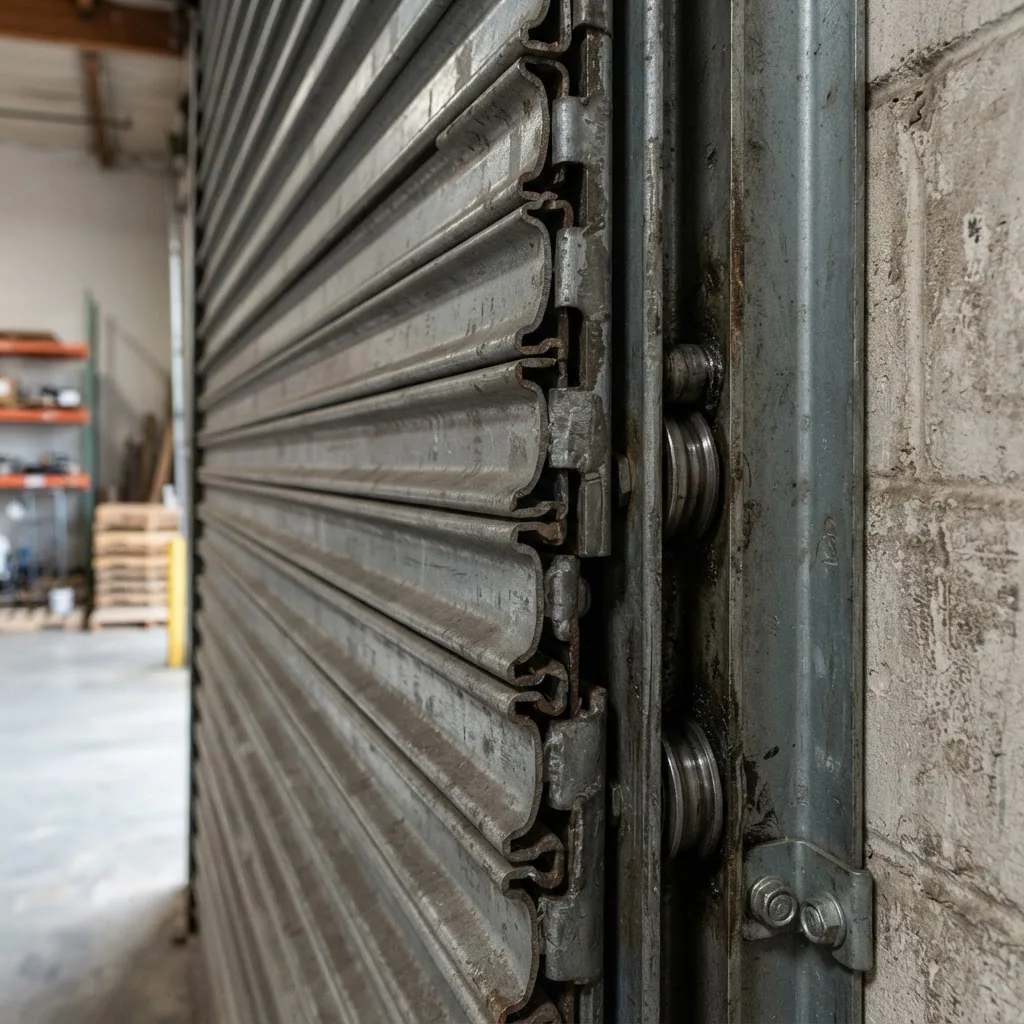
Types of commercial roll up doors vary by application: rolling steel for heavy-duty security; aluminum slat doors for lighter retail applications; and insulated slats for temperature-controlled facilities. How a roll up door works: a curtain of slats rolls onto a barrel as torsion springs store energy; the motor assists or replaces manual force. Key repair needs arise when stored energy is misbalanced, components wear, or environmental forces cause distortion.
Transitioning from diagnosis to specific issues, the next section lists common failures with clear symptom-to-repair mappings.
Common Commercial Roll Up Door Issues Requiring Repair
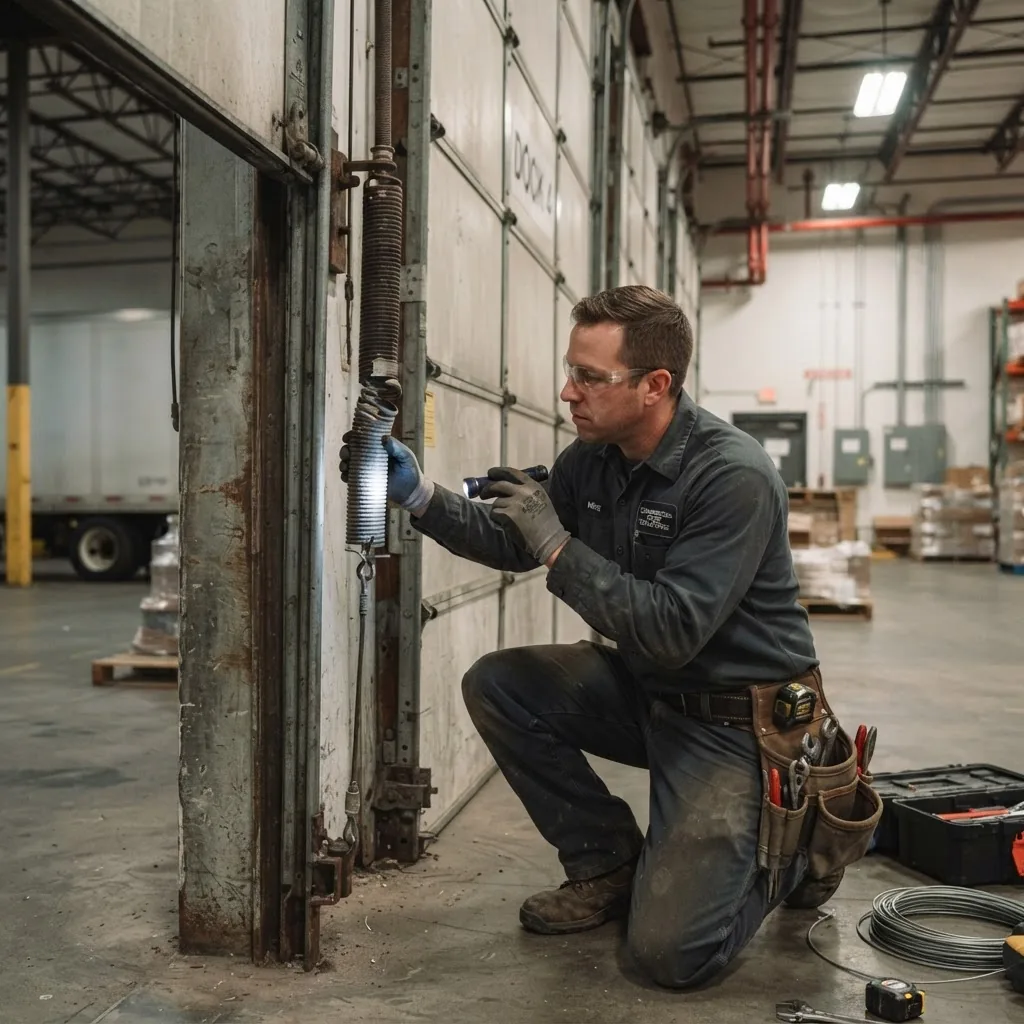
- Broken or fatigued torsion springs: Symptom: door falls rapidly or is extremely heavy to lift. Cause: fatigue from cycles; springs rated by cycles (e.g., 10,000 cycles). Repair: replace matched spring set sized by wire diameter and coil count. Parts cost range: $200–$450 for industrial torsion springs; labor 1–2 hours.
- Damaged slats or panels: Symptom: visible dents, gaps, compromised security or weatherseal. Cause: forklift strikes or corrosion. Repair: replace slat sections or full curtain depending on damage pattern. Parts cost: single slat $75–$250 (steel), full curtain replacement runs $1,200–$6,000 depending on material; labor varies widely.
- Door off-track or bent tracks: Symptom: scraping, uneven travel, door jams. Cause: impact or loose brackets. Repair: realign tracks, replace bent sections, re-secure brackets to structure. Labor intense on larger doors—2–5 hours—and may require structural shims.
- Roller failure and bearing wear: Symptom: grinding noise, visible wobble, accelerated track wear. Cause: corrosion, impact, or lack of lubrication. Repair: replace rollers (nylon or steel) and bearings; recommended to replace in sets to maintain alignment. Parts $12–$45 each; labor 1–3 hours.
- Motor and gearbox failure: Symptom: motor hums but door doesn’t move, slow operation, tripped breakers. Cause: burnt windings, gear wear, or electrical faults. Repair: gearbox rebuild or motor replacement; test motor amps and voltage. Motor replacement can range $600–$2,500 depending on horsepower and control options; labor 1–4 hours.
- Sensor and control issues: Symptom: intermittent operation or safety reversals. Cause: misaligned photo-eyes, damaged conduit, or control board faults. Repair: adjust alignment, replace damaged sensors or control modules. Parts $80–$450; labor 0.5–2 hours.
- Track obstructions and seal failure: Symptom: air infiltration, rodent entry, or curtain dragging. Cause: worn bottom seals or accumulated debris. Repair: replace bottom rubber seals, clean tracks, and add brush seals. Parts $40–$200; labor 0.5–1.5 hours.
- Corrosion and structural failure: Symptom: pitting, weakened brackets, or curtain perforation. Cause: coastal environments or chemical exposure. Repair: part replacement, corrosion treatment, or full curtain replacement; budget for more extensive corrosion mitigation if discovered.
- Control logic and integration failures: Symptom: PLC or integrated access control inconsistencies. Cause: outdated firmware, incompatibility, or lightning damage. Repair: firmware updates, component replacement, or rewiring for compatibility. Costs depend on system complexity.
- Emergency release or brake failures: Symptom: door won’t stay in position or emergency release unavailable. Cause: worn brake pads or faulty emergency mechanisms. Repair: replace brakes, ensure compliance with code for emergency egress devices.
These common issues are mapped to parts and estimated labor in the detailed cost breakdown below.
Detailed Breakdown of Commercial Roll Up Door Repair Costs
Below is a practical cost comparison by repair type. All ranges are estimates; regional labor rates and material availability affect final pricing. According to a 2024 industry report, average commercial repair tickets cluster between $400 and $1,600 for typical repairs. Use this table to frame quotes and scope work.
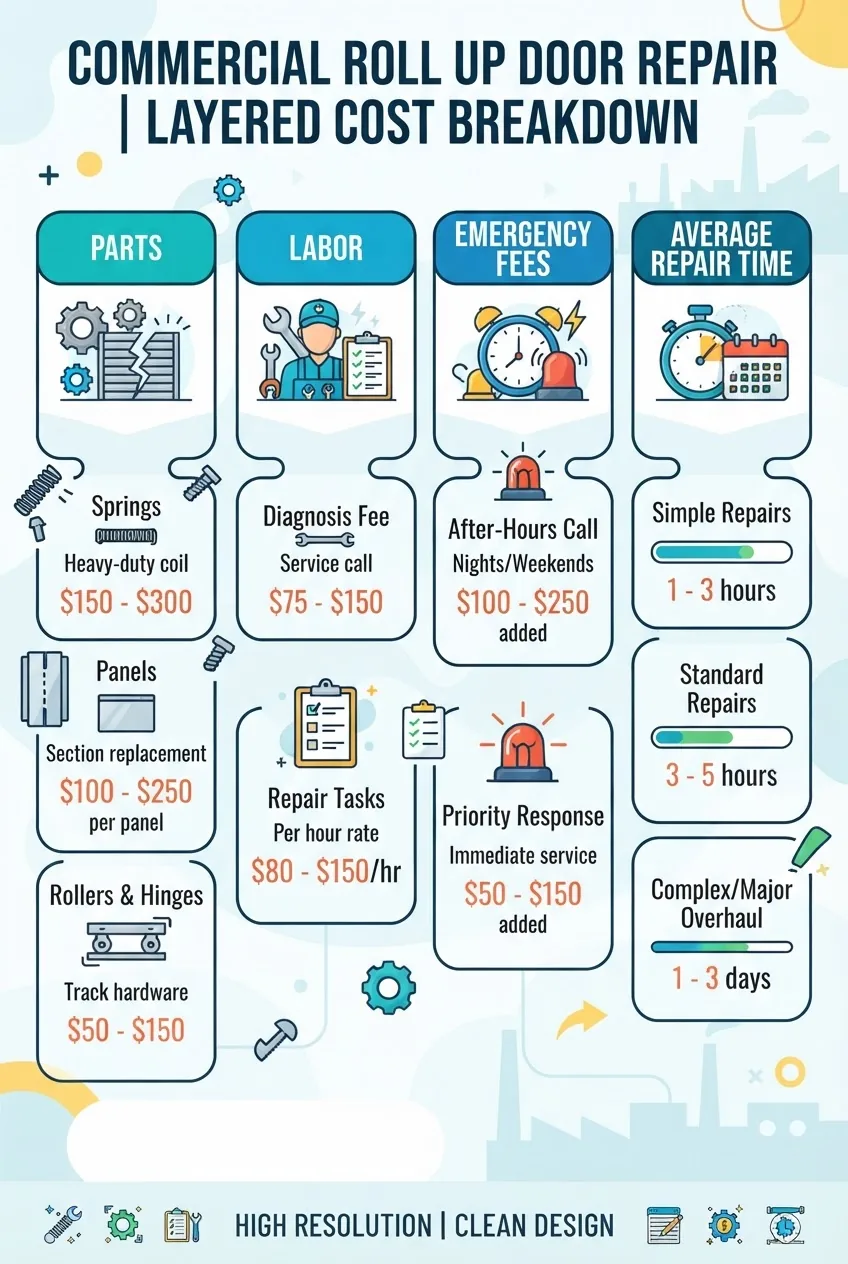
| Repair Item | Typical Parts Cost | Typical Labor (hrs) | Total Typical Range |
|---|---|---|---|
| Torsion spring set (industrial) | $200–$450 | 1–2 | $350–$800 |
| Panel/slat replacement (single) | $75–$250 | 1–3 | $180–$900 |
| Roller replacement (set) | $50–$250 | 1–2 | $150–$600 |
| Motor & gearbox (replacement) | $600–$2,500 | 1–4 | $900–$3,500 |
| Track realignment / structural repair | $80–$400 | 2–5 | $300–$1,500 |
| Sensors & control board | $80–$450 | 0.5–2 | $150–$900 |
| Emergency service fee (after hours) | N/A | Variable | $150–$350 surcharge |
Cost methodology notes: shops often use a fixed labor rate ($95–$150/hr) and apply a parts markup of 10–40% for sourcing and warranty handling. According to a 2024 industry report, emergency callouts can add a 25–50% premium to the total invoice. For broader installation and replacement comparisons see garage door installation and material costs.
Transitioning from price numbers to what professional service includes, the next section outlines the expected service flow and deliverables from experienced commercial teams.
What to Expect from Professional Commercial Roll Up Door Service
Hiring a professional commercial roll up door service should give you an organized inspection, a transparent quote, and tested repairs. Typical service includes diagnostics, written estimates with parts and labor breakdown, safety checks, and post-repair documentation. A quality vendor will also advise on preventive maintenance and warranty impacts.
- Comprehensive inspection and diagnostic report: Expect a written checklist: curtain condition, spring specs, motor amp draw, track alignment measurements, sensor function, and door balance test results.
- Clear estimate and scope: Line-itemed parts, labor hours, emergency fees, and expected lead-times for custom parts. Ask for recommended alternatives with cost and life expectancy.
- Execution with safety compliance: Technicians should implement lockout/tagout and provide LOTO documentation. Confirm they use calibrated tension tools and torque values that match manufacturer guidelines.
- Testing and commissioning: Full-cycle tests under load, verification of auto-reverse and sensor operation, and written verification of final motor amp readings.
- Service agreements and preventative plans: Vendors often offer service contracts (quarterly or biannual) that include lubrication, inspection, and priority scheduling. For ongoing budgeting, refer to commercial garage door maintenance costs.
Service agreements can reduce unexpected downtime. Expect preventative maintenance contracts to cost roughly 10–20% of major repair/year depending on door count and access frequency (according to a 2024 industry survey).
Transition: understanding what drives cost lets you anticipate variables—next we detail those cost factors explicitly.
Factors Influencing Repair Cost and Service Requirements
Repair costs are driven by several measurable factors: door size, material, damage severity, site accessibility, and service provider rates. Below is a concise stat block of cost drivers to check when estimating or comparing quotes.
- Door size: every additional foot of width adds 5–8% to parts and labor relative to a base 10′ door.
- Material type: steel slats cost more to replace than aluminum; insulated slats carry premium of 20–40%.
- Damage severity: localized slat repair typically 30–60% cheaper than full-curtain replacement.
- Accessibility: dock-level doors with cranes or elevated work add 1–3 hours of labor or rental lift charges.
- Service provider rates: certified commercial specialists bill higher but reduce repeat failures—expect +15–30% vs general residential contractors.
Hidden costs and contingencies to watch for: structural framing repairs, hazardous material mitigation (lead or asbestos near coatings), and expedited parts fees. Always add a 10–20% contingency allowance when budgeting for unknowns discovered during disassembly.
Transition: when is a repair the right call versus replacement? The next section provides a structured comparison to decide.
Repair vs Replacement: Making the Best Decision
Deciding between repair and replacement depends on age, cumulative repair costs, security needs, energy performance, and downtime tolerance. Use lifecycle math: if repair costs exceed 40–60% of replacement (adjusted for remaining useful life), replacement is usually the smarter long-term investment.
| Pros | Cons |
|---|---|
| Repair: lower short-term cost; faster turnaround; retains existing integration with access controls. | Repair: may incur repeated service calls; limited lifespan extension depending on remaining component life. |
| Replacement: improved energy efficiency, updated safety features, long warranty, lower maintenance for years. | Replacement: higher upfront cost, longer downtime, possible need for structural modifications. |
Quantitative rule-of-thumb: total cost of ownership (TCO) over 5–10 years, factoring repairs, lost productivity, and energy savings, provides the best decision metric. For large fleets, consider staged replacement to smooth CAPEX and limit downtime per site.
Transition: repairs must meet safety and code requirements—read on for recommended standards.
Ensuring Safety and Compliance During Commercial Roll Up Door Repair
Repair work must meet OSHA guidelines for mechanical guarding, lockout/tagout, and fall protection. For a starting reference, review OSHA workplace safety standards. Manufacturer repair specifications will list torque values, spring specs, and recommended procedures; consult your door’s manual or manufacturer’s repair guidance such as manufacturer guidelines for exact requirements.
Key compliance checkpoints:
- Verify lockout/tagout is in place before work begins (OSHA 29 CFR 1910.147).
- Confirm emergency release mechanisms and egress are functional after service.
- Use manufacturer-specified spring and fastener replacements to maintain warranty and structural integrity; deviation can void warranties.
- Document tests and retain records for the facility’s safety audits.
When sourcing repair rates or setting budgets, cross-reference industry cost estimators such as industry cost estimator reports for current market pricing trends and averages (data referenced from a 2024 industry report).
Transition: many facility managers consider DIY—next we examine risks and when to hire pros.
DIY vs Professional Repair: Risks and Recommendations
DIY work can reduce labor expense but greatly increases risk when torsion springs, heavy curtains, and energized motors are involved. Consider these concise points before attempting any work.
- Safety risk: torsion springs store lethal energy—improper winding causes catastrophic failure.
- Certification: many jurisdictions require certified technicians for commercial door repairs and for work affecting egress or fire-rated openings.
- Cost-benefit: minor replacements (rollers, seals) may be economical DIY; torsion spring and motor work generally requires pros.
- Emergency situations: for doors that compromise security or critical operations, call professional emergency repair services rather than a DIY attempt.
For resources on service providers (residential focus), see residential garage door repair services.
Common mistakes and how to avoid them
From my field experience: I once replaced a single spring on a large curtain because the other spring looked “fine”—two weeks later the second spring failed because the pair had been matched at installation. I now always replace springs as matched sets and document spring specs.
Other observed failures and avoidance steps:
- Overlooking motor amp draw: I saw a motor replaced without checking amps; new motor burned out because track binding wasn’t fixed. Always measure amps before motor replacement.
- Incorrect torque on winding bolts: I have re-torqued drums that were under-torqued, resulting in premature fastener failure. Use manufacturer torque values and a calibrated torque wrench.
- Skipping post-repair load testing: I once left out loaded-cycle testing and the door failed under pallet load. Always perform three loaded cycles with typical operational load.
Final checklist before completion
- Power isolated and LOTO removed only after testing complete.
- Spring specs recorded, label installed with wire, inside diameter and turns.
- Motor amp draw and voltage recorded and attached to job record.
- Sensors aligned and auto-reverse tested for three cycles with weights at bottom edge.
- Maintenance schedule recommended (quarterly or biannual) and warranty documents provided.
When to call a professional
Call professional commercial roll up door service when torsion springs are involved, motor/gearbox work is needed, the door height exceeds 12 feet, structural/frame repairs are required, or doors affect fire/egress routes. For emergency failures that interrupt operations, prioritize certified technicians with commercial experience.
Conclusion
Accurate commercial roll up door repair budgeting requires clear diagnostics, itemized parts and labor estimates, and an understanding of door material and application. Use the diagnostic steps, cost table, and safety checklist here to scope work, compare quotes, and decide repair versus replacement. For complex or safety-critical repairs, engage certified commercial technicians to avoid liability and ensure compliance. If you’re ready to scope a job, take the diagnostics checklist to a trusted vendor for a firm quote and schedule a prioritized service window to limit downtime.