

Types of garage door springs include torsion, extension, double-paired springs and older coil-style springs; each is a counterbalance that offsets door weight and must be matched to opener torque and mounting. This guide explains differences, lifecycle, materials, and opener compatibility so homeowners can choose the correct spring safely.
What are garage door springs and opener systems?
Answer: Garage door springs are mechanical counterbalance components that store energy to lift and lower a door; opener systems are powered units (chain, belt, screw drives) that act on that balanced load to automate movement. Both must be sized and matched to the door weight and spring torque for safe performance.
Counterbalance: a mechanical system (springs, cables, drums) that offsets door weight so the opener handles minimal load.
Garage door opener: a motorized device (chain, belt, or screw drive) that moves the door along tracks and works with the spring counterbalance.
Torsion spring: a horizontally mounted spring that twists to store torque above the door header.
Extension spring: a linear spring mounted along the horizontal tracks that stretches to counterbalance the door.
Understanding these basics prepares you to compare spring types and how they work with different opener technologies.
What are the different types of garage door springs?
Answer: The primary residential spring types are torsion springs, extension springs, double (paired) springs, and older coil-style/early springs; each has distinct mounting, lifecycle, and opener compatibility trade-offs covered below.
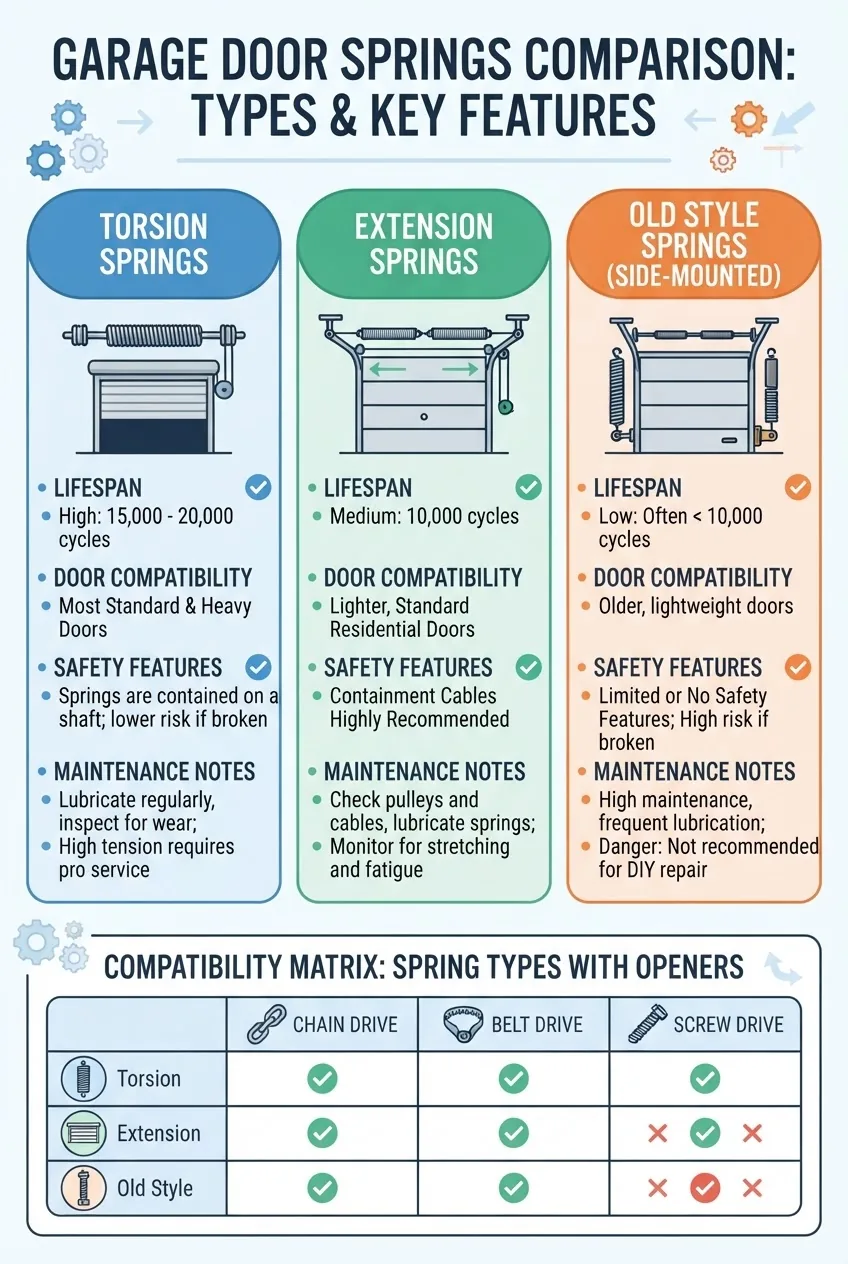
Below is a rapid comparison table with pros and cons per spring type, followed by detailed descriptions and lifespan notes.
| Spring Type | Pros | Cons | Typical Lifespan (cycles) |
|---|---|---|---|
| Torsion springs | Precise balance, longer lifecycle options, cleaner overhead installation, safer with proper containment | Higher upfront cost; professional installation strongly recommended | 10,000–50,000 cycles (standard → high-cycle) |
| Extension springs | Lower cost, simpler installation for many residential doors, widely available | Less precise balance, stretch over time, requires safety cables to contain failure | 5,000–20,000 cycles |
| Double (paired) springs | Balanced load across wider doors, redundancy, longer combined service life | More components to inspect, slightly higher install cost | Varies — typically extends effective cycles vs single spring |
| Old style coil springs | Original fit on vintage doors; sometimes lower cost if reuse is possible | Often worn, limited cycle ratings, compatibility issues with modern openers | Often below 5,000 cycles unless replaced with modern materials |
Detailed notes:
- Torsion springs are mounted on a torsion bar above the door and use torque (twisting force) to lift; they are preferred for precision and high-cycle options.
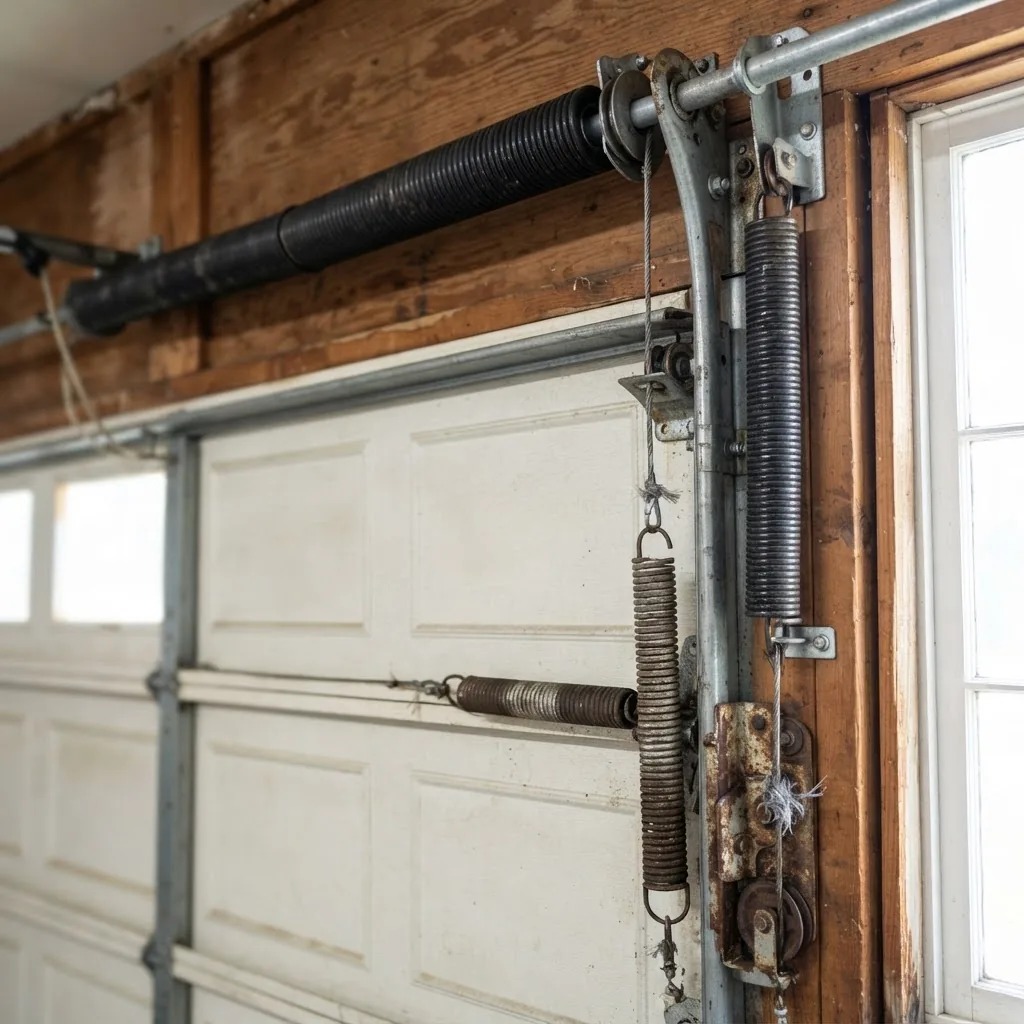
- Extension springs run parallel to the horizontal tracks and store energy by stretching; they need containment safety cables to reduce hazard on failure.
- Double garage door springs refers to paired springs (either two torsion or two extension) used to split load on wider/heavier doors for improved balance.
- Old style garage door springs include early coil designs and small-diameter springs originally used on older doors; these often require replacement with modern equivalents for safety and opener compatibility.
For practical selection, consider door weight, height, width, cycle expectations, and whether you plan to pair springs with a new opener; the next section describes torsion systems in depth.
How do torsion system garage door springs work?
Answer: A torsion system uses one or two torsion springs mounted on a steel shaft above the door; when wound they store torque that is transferred through drums and cables to counterbalance the door weight so the opener moves the door with minimal load.
Term: torque — a rotational force applied to a shaft or spring, measured as force times distance.
- Torsion bar / shaft — a hollow or solid steel shaft that runs above the door and carries the springs; torque on this shaft is what lifts the door.
- Springs — usually paired (left/right) wound either inward or outward to provide balanced torque; spring count and size depend on door weight and desired cycle life.
- Spring mounting brackets — anchor springs to header and to the torsion tube; they keep the springs aligned with the shaft.
- End bearings and center bearing — support the torsion shaft and allow it to rotate as torque is applied and released.
- Winding cone and set screws — used to set initial spring tension on installation (professional service recommended for safety).
- Drums and lift cables — drums on the torsion shaft convert shaft rotation into cable spooling/unspooling to raise and lower the door.
Operation summary: when the door is closed the torsion springs are wound, storing torque; when the opener or manual release actuates, the stored torque helps lift the door and reduce the load on the motor. Torsion springs offer precise balance, easier cable alignment, and better options for high-cycle (long-life) springs.
Installation considerations (overview only):
- Mounting requires a header with reinforced brackets and a straight torsion shaft spanning the door width.
- Spring selection uses door weight, drum radius, and desired cycles to compute wire size and coil diameter (manufacturer specs required).
- Winding and set-screw torquing are hazardous; industry guidance and local regulations recommend professional installers for torsion work.
According to a 2024 industry report, homeowners upgrading to torsion systems see fewer emergency failures vs extension springs in comparable installations, but professional installation costs are higher — see compatibility notes next.
Transition: After torsion mechanics, the next section explains extension springs and where they remain appropriate.
What are extension garage door springs and their features?
Answer: Extension springs run parallel to the horizontal tracks and balance the door by stretching; they are common on older and many residential doors because they are economical and straightforward, but they require safety cables and routine inspection to manage failure risk.
Term: extension cables — cables used with extension springs to attach springs to track hangers and carry load to the door; safety cables run through extension springs to contain them if they break.
Typical uses:
- Single-car and light-weight residential doors where economy is a priority.
- Doors with straightforward horizontal track layouts and modest cycle requirements.
- Retrofits where heads or header space make torsion installation impractical or costly.
Key safety features and typical installation components:
- Safety cables run inside extension springs to prevent the spring from whipping if it breaks — mandatory on many installations.
- Hanger brackets secure springs to the track and header; their spacing affects how springs stretch under load.
- End loops or cone fittings attach springs to stationary points and to the track-support assembly.
- Regular inspection for corrosion, elongation, and broken coils is required to detect fatigue.
If you need replacement parts or precise sizing guidance for extension springs, refer to the dedicated guide: extension garage door springs replacement and sizing.
Additional safety and cable work often requires simultaneous cable replacement; for detailed cable procedures consult the specific cable guide: garage door cable replacement and installation.
Transition: With extension characteristics noted, the following section compares older spring designs to modern equivalents and conversion challenges.
What are old style garage door springs and their modern equivalents?
Answer: Old style garage door springs—early coil-style or small-diameter springs—were common on vintage doors but generally have lower cycle ratings and poorer materials; modern equivalents use higher-grade steel, improved coatings, and standard torsion or extension geometries for safety and compatibility.
| Characteristic | Old Style Coil Springs | Modern Equivalent |
|---|---|---|
| Material & treatments | Lower-grade carbon steel, minimal coatings | Oil-tempered alloy steels, galvanized or powder coatings |
| Cycle life | Often <5,000 cycles | 10,000–50,000 cycles available |
| Compatibility with openers | May not align with modern opener gearing/torque; conversion often needed | Designed to match modern torsion/extension standards and opener torque curves |
Case study (conversion scenario):
- A 1950s single-car garage used small coil springs with a lightweight manual door; owners wanted an opener for convenience.
- Assessment showed springs under-rated for modern opener torque and no safety containment; conversion to a short torsion assembly was recommended.
- Steps taken: door weight measured, header reinforced, torsion shaft and high-cycle torsion springs specified, drums and cables matched, and professional installer performed the conversion.
- Result: improved balance, compatibility with a belt-drive opener, and longer expected cycle life per manufacturer specs.
According to a 2023 manufacturer specification summary, converting from old coil springs to modern torsion options typically increases expected cycles by 2–5x depending on chosen spring rating and material treatment — always confirm with manufacturer data before conversion.
Transition: Many homeowners opt for paired springs on wider doors; read on for when double springs make sense and how they affect support needs.
Why use double garage door springs and when are they appropriate?
Answer: Double garage door springs (paired springs) split the door’s load across two springs—improving balance, redundancy and lifecycle on wider or heavier doors; they are recommended for doors wider than 8 feet or for owners seeking greater longevity and safety margin.
Scenario examples:
- Scenario A: A 16-foot two-car door weighs 200 lbs — using double torsion springs reduces per-spring stress and simplifies replacement scheduling.
- Scenario B: A homeowner with heavy insulated door aiming for a quieter belt-drive opener chooses dual springs to minimize opener torque demand and extend spring service life.
Key advantages list:
- Balanced load distribution reduces individual spring stress and can increase overall cycle life.
- Redundancy: if one spring begins to fail, the door may remain somewhat supported until replacement (not a reason to delay service).
- Improved safety and smoother operation when paired with proper drums, cables, and struts.
- Easier tuning for heavier doors and better compatibility with high-torque openers.
Support considerations: wider doors often require additional reinforcement like struts or center supports; see the support guide for structural recommendations: garage door struts and supports.
Transition: With load-sharing and support covered, the next section explains how springs interface with opener systems and what to check for compatibility.
Which garage door springs are compatible with which opener systems?
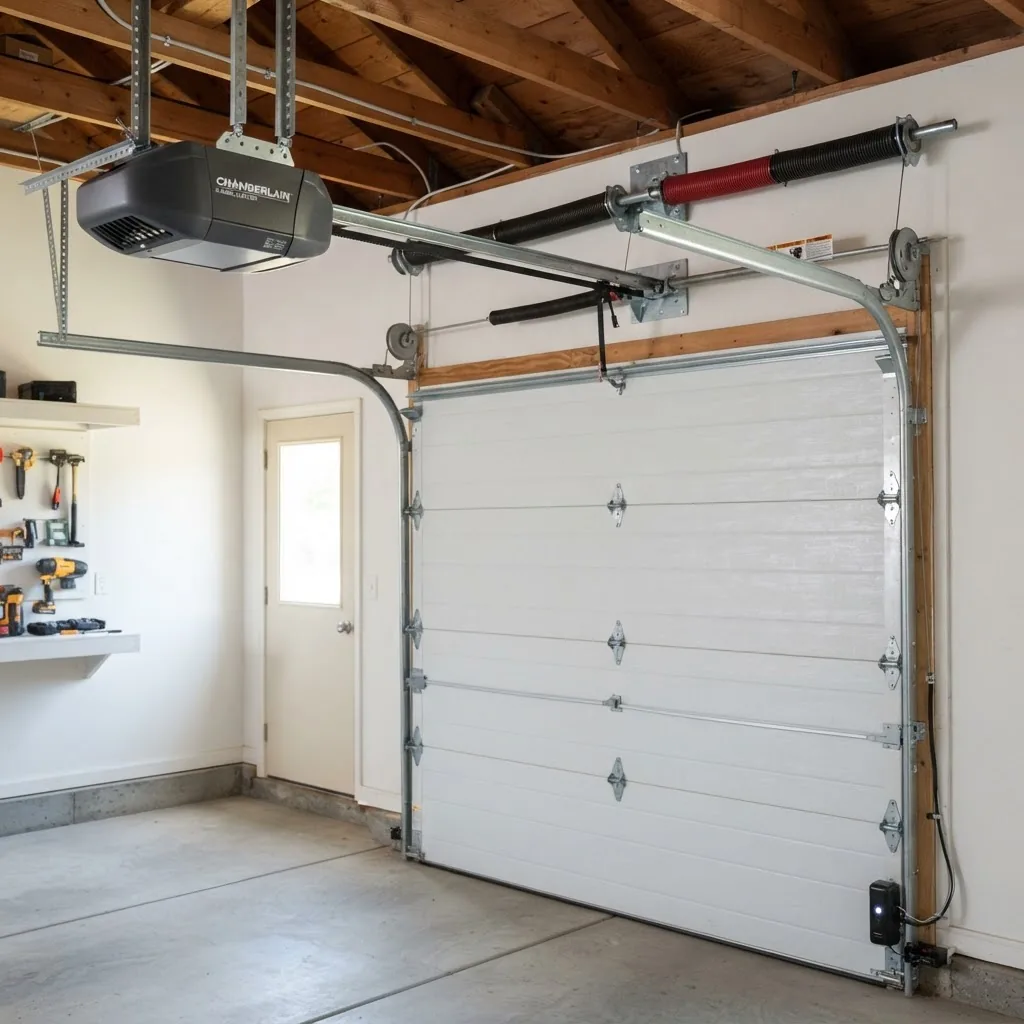
Answer: Most modern torsion and extension springs can work with chain, belt, and screw drive openers if the spring counterbalance is correctly set and the opener’s torque rating matches the remaining unbalanced load; opener selection depends on door balance, desired noise level, and duty cycle.
Compatibility factors to verify:
- Opener torque and horsepower vs door weight and spring counterbalance.
- Whether the spring system leaves a small residual load the opener must overcome (openers are not designed to lift a fully unbalanced door).
- Mounting geometry — torsion systems require header space; screw drives may tolerate some configurations that belt drives do not.
- Service cycle expectations: commercial doors or very frequent use may require heavy-duty openers and high-cycle springs.
| Opener Type | Compatibility Notes | Spring Considerations |
|---|---|---|
| Chain drive | Durable and cost-effective; noisier but handles heavier doors well. | Works with both torsion and extension springs if counterbalance is correct; choose springs that minimize residual load. |
| Belt drive | Quieter and smoother; ideal for attached garages and residential settings. | Best paired with well-balanced torsion systems for smooth, low-vibration operation. |
| Screw drive | Fewer moving parts; performance varies with temperature and load. | Compatible with both spring types but sensitive to small unbalanced loads—ensure correct spring sizing and maintenance. |
Practical step-by-step to match springs and an opener (high-level identification):
- Measure door weight and dimensions; note existing spring type and drum diameter.
- Determine required counterbalance torque: multiply door weight by half the drum diameter to estimate torque demand (manufacturer formulas vary).
- Compare required torque to spring ratings and opener torque specifications; select a spring that provides most of the lift so the opener only supplies minimal assist.
- Confirm mounting geometry and header-space for torsion assemblies or track clearance for extension springs.
- Specify opener horsepower/torque and duty cycle according to door use; choose belt drives for quiet, chain drives for heavy-duty cost-effectiveness.
Professional installers and manufacturer specifications should verify spring wire size, wind count, and drum radius to finalize selections; for budgeting and installation trade-offs consult the pillar resource on costs: garage door prices and installation costs.
Transition: Compatibility checks lead directly into safety, maintenance, and when to call for replacement or emergency service.
When should garage door springs be maintained or replaced and how do I stay safe?
Answer: Replace springs when you observe signs of fatigue or broken coils, when doors become unbalanced, or when springs exceed expected lifecycle; always prioritize safety—do not attempt torsion spring repairs yourself and call professionals for hazardous tasks.
Signs of spring failure:
- Visible broken coils or a visibly shorter spring length.
- Door is unbalanced—when partially opened it drifts up or down instead of holding position.
- Unusual noise during operation (loud bangs or repeated snapping sounds).
- Rust, heavy pitting, or stretched appearance on extension springs.
Safety checklist and maintenance steps (high level):
- Visual inspection every 6–12 months for corrosion, gaps in coils, or frayed cables.
- Verify safety cables on extension springs are present and intact.
- Confirm opener sensors and manual release operate properly.
- Schedule professional inspection if you hear unusual noises, see wear, or if springs approach expected cycle life.
Regulatory and authority guidance: for safe handling and workplace practices consult government standards: OSHA and for consumer safety information see CPSC. For manufacturer-specific material and cycle specs reference major OEM data: Clopay specifications.
If a spring fails suddenly and the door is jammed or hanging unevenly, seek urgent assistance — learn options for rapid response here: emergency garage door repairs.
For routine longevity, review recommended maintenance schedules and tune-up advice in our maintenance guide: garage door maintenance and tune-up tips, and avoid DIY spring winding without proper training — professional evaluation is the safest route.
Transition: With safety and maintenance covered, the final section summarizes selection steps and next actions for homeowners.
How do I choose the right garage door springs and what are the next steps?
Answer: Choose springs based on measured door weight, width, desired cycle life, and compatibility with your chosen opener; prioritize torsion for precision and longevity on most modern residential doors, and engage a professional installer to verify calculations and handle hazardous tensioning.
Selection guide (concise):
- Measure door width, height, and weigh the door (or have a pro do it).
- Decide target cycle life (standard 10k cycles vs high-cycle 25–50k options).
- Select spring geometry: torsion usually preferred; extension acceptable for lighter doors with safety cables.
- Match with opener type (chain, belt, screw) considering noise and torque requirements.
- Confirm materials: oil-tempered alloy steels with coatings resist corrosion and extend life.
Warranty and professional services: verify manufacturer warranty on springs and ask the installer for documented spring specifications and expected cycles; keep manufacturer paperwork for future claims.
For coordinated hardware upgrades after spring replacement, consider a hardware refresh: garage door handle replacement and hardware.
Final recommendations: For most homeowners, upgrading to a correctly specified torsion spring and pairing it with a quiet belt-drive opener provides the best balance of safety, longevity, and low noise. Always confirm specifications with manufacturer data and use licensed professionals for installation.
Next step: if unsure about your door’s current balance or spring condition, schedule a professional inspection and obtain written spring specifications before purchasing an opener or attempting replacement.