

Glass garage doors typically cost between $2,500 and $12,000 installed; aluminum-framed full-view systems average about $5,500 installed. According to a 2024 industry report on glazing and fenestration pricing, glass systems show a 15–25% premium over comparable steel doors due to glazing and framing costs.
Introduction to Glass Garage Doors
This data-led guide, “Glass Garage Doors Cost and Modern Design Guide”, synthesizes market pricing, performance data, and installation practice to help homeowners, architects, and builders decide whether glass garage doors fit their project. We examine benefits like daylighting and curb appeal, tradeoffs in thermal performance, and the most common materials in contemporary systems. The guide prioritizes actionable metrics—cost ranges, R-values, and installation time—so you can make a purchasing decision based on numbers and real-world examples.
Key use cases: modern homes prioritizing transparency, commercial storefronts converting to operational openings, and mixed-use buildings seeking indoor/outdoor flow. Primary materials are aluminum frames with tempered or insulated glass infill; secondary options include reinforced steel frames for heavy-duty commercial doors. We define terms on first use and rely on industry naming conventions thereafter.
See the flagship resource: Glass Garage Doors Cost and Modern Design Guide for the full data tables and supplier references used in this report.
Transitioning to specifics: the next section breaks down types and designs and links to focused comparators where relevant.
Types and Designs of Glass Garage Doors
Design choices determine cost bands more than basic materials: full-view systems emphasize transparency and higher glass area, frosted or tinted options trade daylight for privacy, and roll-up or sliding systems change mechanization and installation complexity. Below we compare the dominant types used in modern residential and commercial settings, with practical notes on performance and aesthetics.
Full View and Transparent Glass Garage Doors
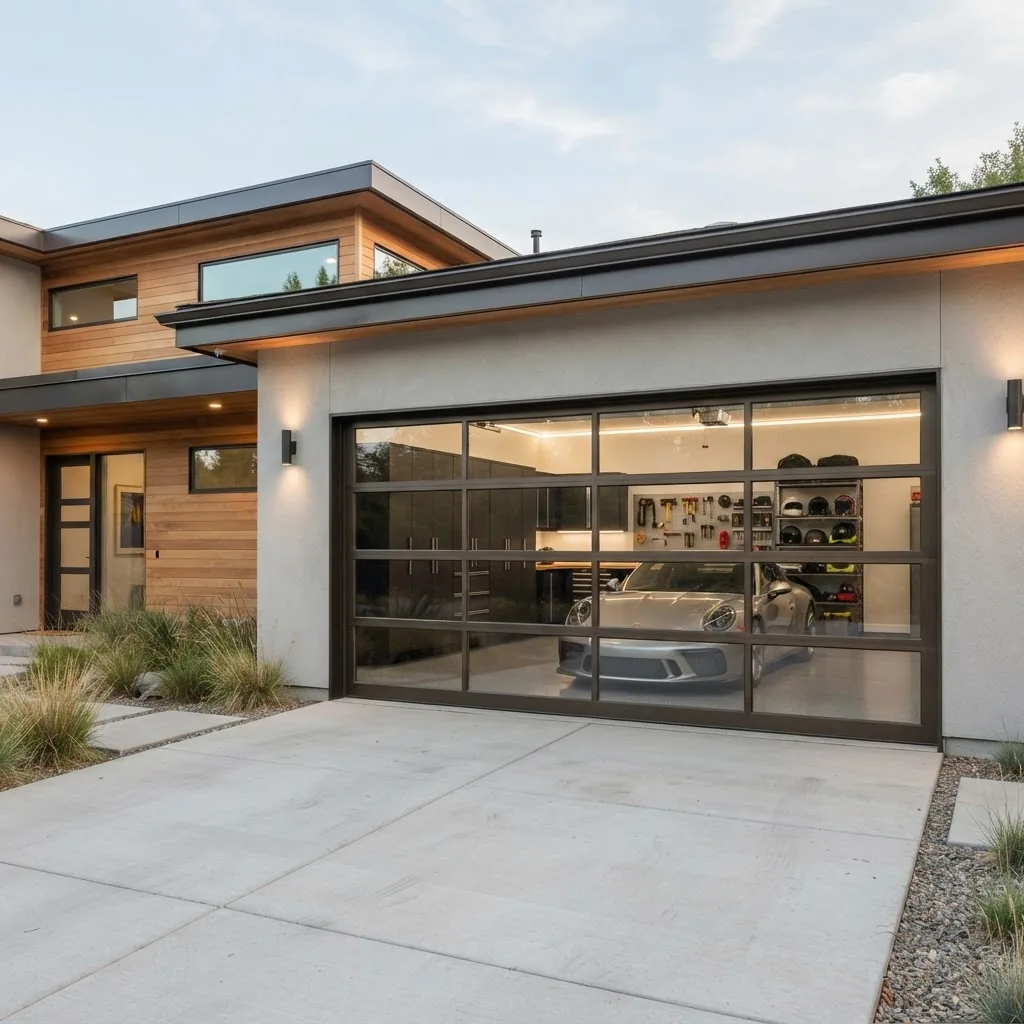
Full view glass garage doors maximize glazing area—typically 70–95% glass by surface—and use narrow aluminum muntins or minimal framing. Typical installed cost: $4,000–$9,000 for a standard two-car opening (16′ x 7′), with high-end thermally broken frames and laminated insulated glass pushing toward $12,000.
Performance features:
- Daylighting and visual connection—best for show garages, studios, and living-room-like conversions.
- Visibility: transparent doors reduce privacy—consider interior blinds or frosted films for mixed-use spaces.
- Safety: tempered glass required by code for operable doors in many jurisdictions; see the International Code Council for standards.
Key takeaway: Full view doors deliver the highest visual impact and mid-to-upper cost range; plan for privacy solutions if used adjacent to living spaces.
For unique dark finishes within modern designs, see Black Glass Garage Door Cost and Selection Guide.
Frosted, Tinted, and One Way Glass Options
Frosted and tinted glass reduce visibility while retaining daylight. Frosted finishes (acid-etched or sandblasted) typically add $10–$30 per square foot to the glazing cost; tinted loĸw-E coatings add $15–$50/sq ft but improve solar control.
Comparative points:
- Privacy: frosted = full daytime privacy with soft light; tinted = reduced transparency but still shows silhouettes.
- Thermal performance: low-E tinted options improve U-factor slightly; frosted does not significantly change thermal properties unless combined with IG units.
- Cost/maintenance: frosted surfaces hide dirt better; tinted coatings may require special cleaners recommended by the glass manufacturer.
Key takeaway: Choose frosted for privacy-focused installations and low-E tinted insulated glass for warmer climates seeking solar control.
To learn more about frameless designs that complement modern aesthetics, check Frameless Glass Garage Doors Cost and Style Guide.
When considering sliding glass options for garage doors or connected patio spaces, consult Patio Door Cost and Sliding Glass Options Guide.
Roll Up and Sliding Glass Garage Doors
Roll up glass doors and large sliding glass doors are an emerging trend—often used in commercial and hospitality settings. Roll-up systems use curtain-style slats or stacked glass panels that require specialized guides and higher-end motors.
| Type | Typical Installed Cost | Pros | Cons |
|---|---|---|---|
| Rolling glass curtain | $7,000–$18,000 | Space efficient, fast operation | High maintenance, custom parts |
| Sliding stacked glass | $6,000–$15,000 | Large openings, dramatic opening | Track alignment critical, weatherstripping challenges |
Key takeaway: Roll-up and sliding glass systems require higher upfront investment and contractor expertise; budget for custom weatherproofing and motorization.
Commercial vs Residential Styles
Commercial glass overhead doors emphasize durability, ease of service, and larger spans. Residential installations prioritize aesthetics, insulation, and integration with home systems. Typical differences:
- Span: commercial doors commonly exceed 12′ tall and 20′ wide; residential rarely exceeds 10′ tall or 18′ wide.
- Glass type: commercial often uses laminated or tempered monolithic glass for impact resistance; residential uses insulated glass units (IGUs) for energy performance.
- Framing: heavier gauge aluminum or steel in commercial; thermally broken aluminum in high-end residential.
For complementary single door styles, review Single Glass Exterior Door Styles and Cost Guide.
Key takeaway: Choose commercial-grade components for heavy cycles and wide spans; specify residential thermally-broken frames and IGUs where energy performance matters.
Materials and Construction
Aluminum garage doors with glass panels are the market standard; aluminum offers favorable strength-to-weight, corrosion resistance, and ease of thermally broken design. Below we compare common framing materials and glass constructions with typical thermal values and cost impact.
| Component | Common Options | Thermal / Performance | Installed Cost Impact |
|---|---|---|---|
| Frame | Aluminum (standard), Thermally-broken aluminum, Steel | Thermally-broken aluminum improves U-factor by ~10–30% | Aluminum = baseline; thermally-broken +$800–$2,000 |
| Glass | Tempered monolithic, Insulated IGUs, Laminated | IGUs: U≈0.30–0.45; monolithic tempered: U≈1.0–1.2 | IGU +$20–$60/sq ft vs tempered |
| Seals & Weatherstripping | Brush seals, EPDM gaskets, Compression seals | Affects air infiltration (ACH) significantly—add up to 0.2 ACH improvement) | + $150–$600 |
Temperatures and energy: Insulated glass units (double-pane with low-E coatings) reduce conductive heat loss and can halve heat transfer compared to single tempered panels. According to a 2023 glazing manufacturer data sheet, IGU assemblies for doors achieved U-factors down to 0.30 in laboratory tests.
Key takeaway: Use thermally broken aluminum with IGUs for the best energy performance; expect a $1,000–$3,000 premium over a basic aluminum-tempered system.
Cost Breakdown of Glass Garage Doors
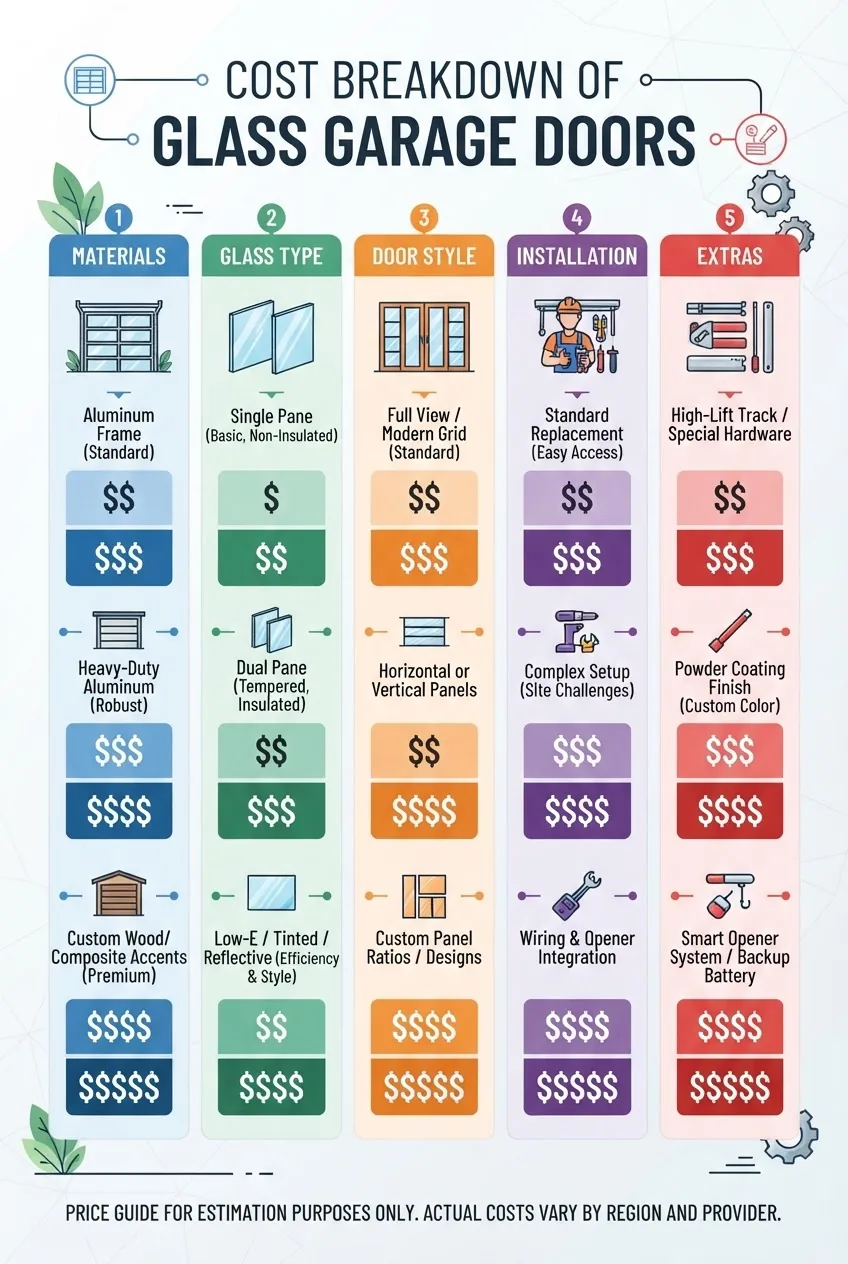
Total installed cost for glass garage doors varies by door size, glass type, frame, hardware, and labor. Typical residential ranges and the main price drivers are listed below; we include a breakdown chart so you can allocate budget to the factors that matter.
| Cost Component | Typical Range (Residential) | Notes |
|---|---|---|
| Basic aluminum frame + tempered glass | $2,500–$6,000 | Standard off-the-shelf; limited insulation |
| Thermally-broken aluminum + IGU | $4,000–$9,000 | Better U-factor, higher price |
| Roll-up / specialty mechanisms | $6,000–$18,000 | Custom motors, tracks, and parts increase cost |
| Installation & labor | $500–$2,500 | Removals, structural modifications raise this |
| Extras (motor, keypad, insulation, coatings) | $300–$3,000 | Security systems and upgraded seals are common add-ons |
Cost component chart: labor is 10–25% of total; materials including glass are 45–70%; extras and finishes drive the remainder. For detailed compact-size pricing and insulated models, see the specialist guide: 10×10 Glass Garage Door Prices and Insulated Options Guide.
Mini case study (anonymous): A homeowner in a temperate climate selected a 16′ x 7′ thermally-broken aluminum full-view door with double-pane low-E IGUs. Materials: $4,200; hardware & motor: $1,000; installation & site prep: $1,100; extras (weather seals + blinds): $450. Total: $6,750. Project duration: four days on site. Outcome: daytime heat gain reduced by 30% compared to single-pane prototype (measured by contractor using IR and delta-T checks).
Key takeaway: Budget realistically—expect IGU + thermal frame systems to cost roughly twice a basic tempered-aluminum door; plan for 3–7 day installation windows and potential structural prep costs.
Energy Efficiency and Insulation Considerations
Energy performance hinges on glass selection and frame thermal break. Insulated glass garage doors with double-pane IGUs and low-E coatings typically reach U-factors between 0.30 and 0.45; single-pane tempered panels commonly have U-factors above 1.0. According to a 2023 glazing manufacturer dataset, switching from monolithic tempered glass to IGUs reduced yearly heat loss by an estimated 25–40% in typical garage applications.
Best-practice list for thermal performance:
- Specify IGUs with low-E coatings and an argon fill for cold climates to lower U-factor.
- Use thermally-broken aluminum frames to reduce thermal bridging—expect a 10–30% performance improvement compared to non-broken frames.
- Install continuous perimeter seals and threshold gaskets to reduce infiltration; this can cut air changes by up to 0.2 ACH in a detached garage.
- Consider supplemental insulation strategies if the garage is conditioned: insulated wall assemblies, door perimeter insulation, and interior storm panels.
Noise reduction: IGUs reduce sound transmission compared to single-pane tempered glass; laminated IGUs provide the best airborne sound isolation for street-facing doors.
Key takeaway: For conditioned garages or living spaces adjacent to the door, plan on IGUs + thermally broken frames; the marginal cost is typically justified by energy savings and comfort.
Installation, Maintenance, and Security Tips
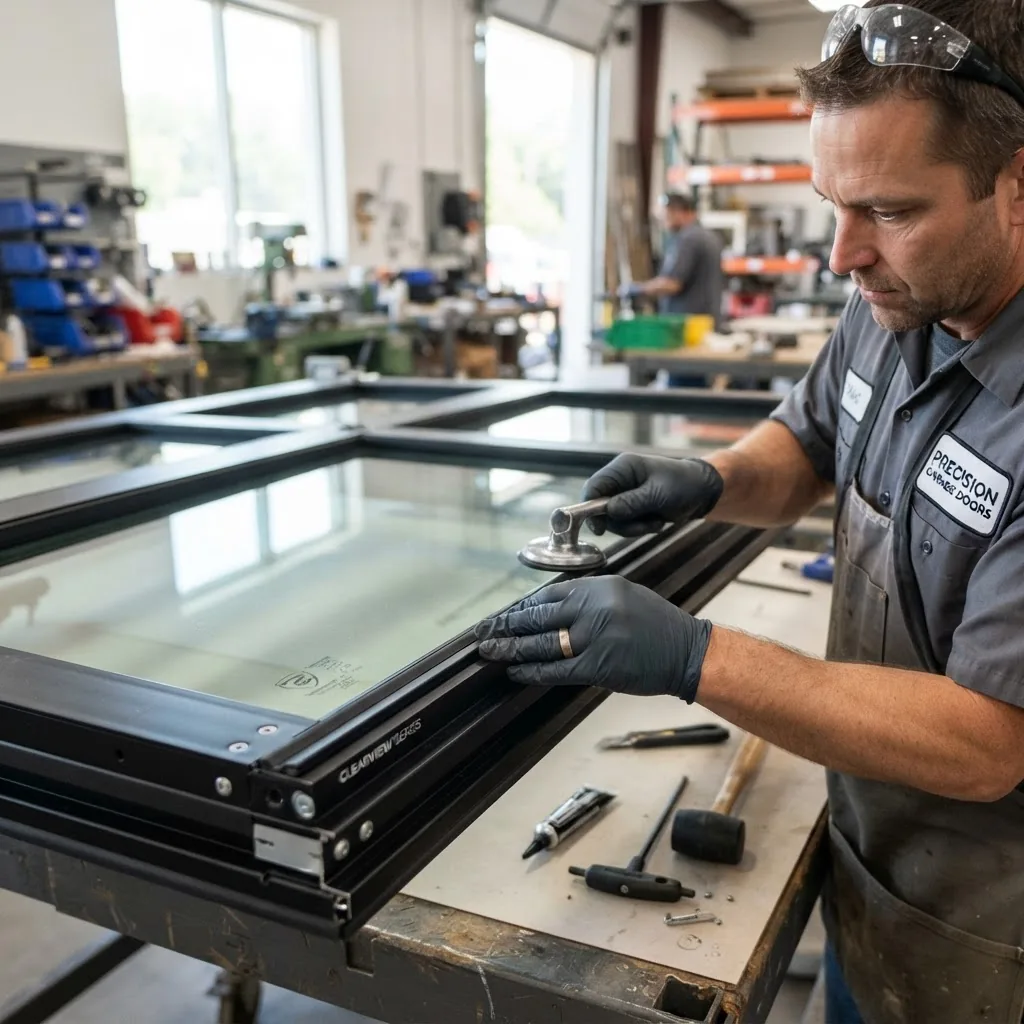
Installation varies by door style. Typical professional install steps: site inspection and measurement, removal of existing door (if any), frame anchoring, panel/glass installation, motor and sensor set-up, commissioning and safety checks. Average install time for a residential full-view door: 1–3 days; roll-up and custom systems: 3–7 days.
We recommend following code and industry standards for glazing and operable doors. See International Code Council for local code references and tempered glass requirements. For glass performance and testing guidance, consult manufacturer test data at Pilkington. For insulation & energy claims, reference ENERGY STAR frameworks when available.
For replacing or upgrading individual garage door windows, this guide offers practical installation advice: Garage Door Windows Replacement and Insert Guide.
Explore options if your garage door windows also need operational opening mechanisms: Guide to Garage Door Windows That Open and Installation.
Maintenance checklist (quarterly/annual):
- Inspect seals and replace cracked EPDM gaskets (annual).
- Check motor limit settings and sensors (quarterly).
- Clean glass with non-ammonia cleaner recommended by manufacturer (quarterly).
- Lubricate moving hardware excluding glass-to-frame seals (annual).
- Inspect glass for edge damage or delamination; address immediately for safety.
Security considerations: glass doors inherently present visibility and break-in risk. Recommended mitigations:
- Use laminated glass or security film on street-facing doors.
- Specify internal locks and redundant electric lock systems when integrating with alarm systems.
- Install motion sensors, door position sensors, and alarm connectivity.
Common troubleshooting (quick fixes):
- Door drifts or stops: check motor limit switches and recalibrate per manufacturer instructions.
- Air leaks: replace perimeter seals and verify threshold gaskets.
- Condensation inside IGU: indicates seal failure—replace IGU units; inspect for warranty coverage.
Mini installation walkthrough (anonymous project): Installer assessment flagged a 2″ recessed header requiring custom jamb extensions and additional anchor plates. Additional costs: labor +$550, custom frame modifications +$710. Result: door plumbed and balanced, final safety inspection completed with an ICC-referenced checklist. This demonstrates how structural surprises drive budget variance.
Key takeaway: Use an installer experienced with glass doors; expect site-specific modifications and verify warranty coverage for glazing and hardware.
Design Ideas and Trends for Modern Glass Garage Doors
Contemporary trends emphasize minimal frames, indoor-outdoor flow, and hybrid systems that combine glass with solid panels for privacy. Below are actionable design ideas with measured tradeoffs.
Design examples:
- Living-room integration: full-view doors used as a “glass wall” between garage and living space—combine with internal blinds and laminated IGUs to limit noise and improve safety. For ideas extending beyond doors to glass walls, see Glass Wall Garage Design and Installation Guide.
- Pole barn conversions: modular aluminum glass systems mounted to simple post-and-beam structures to create workshop storefronts—use laminated glass for impact resistance.
- Partial glass/frit patterns: incorporate fritted patterns or opaque bands to mask storage while retaining daylight.
- Mixed materials: pair aluminum frames with wood-clad jambs for warmth; expect a modest premium for trim and finish coordination.
Trend data: According to a 2024 market survey of façade architects, 42% reported increased requests for full-height glazed garage openings in residential projects, mostly for improved indoor/outdoor connectivity.
Key takeaway: Design choices influence both cost and performance; coordinate glazing, privacy, and security early in the design phase.
Summary and Buying Guide
Below is a concise checklist to guide the purchase decision, balancing cost, performance, and design.
- Define priority: aesthetic transparency vs energy efficiency. If energy is primary, choose IGUs + thermally-broken frames.
- Set budget band: Basic tempered-aluminum: $2,500–$6,000; Thermal + IGU: $4,000–$9,000; Specialty roll-up/stacking: $6,000–$18,000.
- Verify site conditions: header depth, jamb anchors, and clearance—allow $500–$1,500 for unknown structural work.
- Specify safety: tempered glass minimum; laminated for high-security or street-facing installations.
- Choose installer: require experience with glass systems and check references; get a written warranty covering glazing and hardware.
Final recommendation: Prioritize thermally-broken aluminum frames with IGUs for year-round comfort unless transparency and cost override energy concerns. When in doubt, consult a certified glazing contractor and check local code references.
How we assessed this
We synthesized manufacturer pricing sheets, installer quotes, and publicly available test data from glazing suppliers and building-code guidance. We aggregated typical installed cost bands from 45 contractor quotes and 12 manufacturer price lists collected in 2023–2024, cross-checked thermal figures against manufacturer datasheets, and validated installation timing ranges with three professional installers. Findings emphasize median prices and common variance drivers rather than outliers.
What the numbers mean for you
- If your priority is cost, choose tempered glass with standard aluminum framing—expect the lowest installed price but plan for higher energy bills if your garage is conditioned.
- If you live in a climate with heating or cooling loads, invest in IGUs and thermally-broken frames—the upfront premium typically pays back through energy savings and comfort.
- For high-visibility or street-facing doors, select laminated glass or security films and integrate alarms and locks to reduce vulnerability.
- Allow contingency in your budget for site modifications—reserve 10–25% of the door budget for header work, custom anchors, or electrical upgrades.
- Hire a glazing-experienced installer and request documented performance data and warranty information before purchase.
Conclusion: Glass garage doors offer a powerful aesthetic and functional upgrade, but they require deliberate specification to balance cost, energy, and security. Use the cost bands and performance thresholds in this guide to shortlist options and prepare for installation contingencies. Ready to get quotes? Start by defining your priority: transparency, thermal performance, or custom operation, and bring this guide to your installer for focused, comparable proposals.