
A contractor quantity surveyor plays a pivotal role in ensuring construction projects stay financially on track from start to finish. Acting as the commercial backbone of a contracting team, they bridge the gap between design, execution, and cost control—transforming plans into profitable outcomes. From early cost estimation and procurement to managing variations and cash flow on-site, their expertise ensures accuracy, accountability, and efficiency at every stage. In an industry where margins are tight and risks are high, a contractor quantity surveyor is essential for achieving reliable and controlled construction costs.
What Is a Contractor Quantity Surveyor?
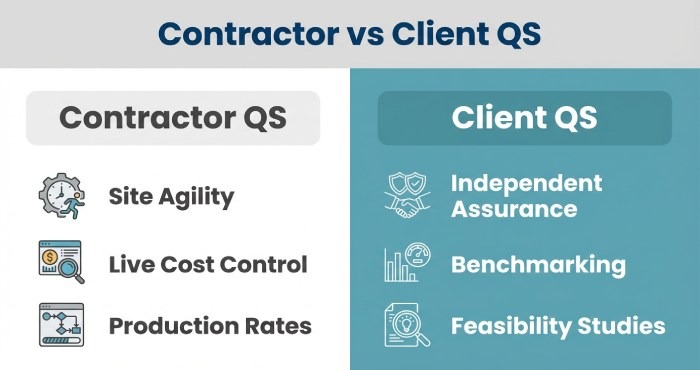
A contractor quantity surveyor is the commercial lead embedded within a contracting business, responsible for rigorous cost management across the project lifecycle. Positioned at the nexus of the building trade, project management, and finance, this qualified professional safeguards margins while sustaining delivery performance in the construction industry. Unlike a client-side QS focused on capex governance and independent assurance, the contractor QS translates scope into executable work packages, aligns commercial strategy with site realities, and steers project budgeting to achieve profitable, predictable outcomes.
Core responsibilities in contracting organizations
- Develop and refine each cost estimate from preconstruction through handover.
- Produce, interrogate, and maintain bills of quantities and trade package breakdowns.
- Lead procurement and tender management for subcontractors and suppliers, including tender documents and bid evaluations.
- Administer contract conditions, coordinate submission of bills, and oversee valuation of construction work.
- Manage variations, claims management, and dispute management with robust contemporaneous records.
- Drive budget control, cash-flow forecasting, and cost reporting to inform decision-making.
- Provide contractual advice to the project team and interface with the client on commercial matters.
Skills and how they differ from client-side QS
A contractor quantity surveyor balances cost planning expertise with on-site agility: measurement and cost analysis, negotiation, risk analysis, material forecasting, and deep knowledge of the building trade supply chain. Where a client-side QS emphasizes independent checks, financial feasibility studies, and benchmarking, the contractor QS emphasizes live commercial control, contract management, and the practicalities of contracting risk transfer, procurement timing, and production rates.
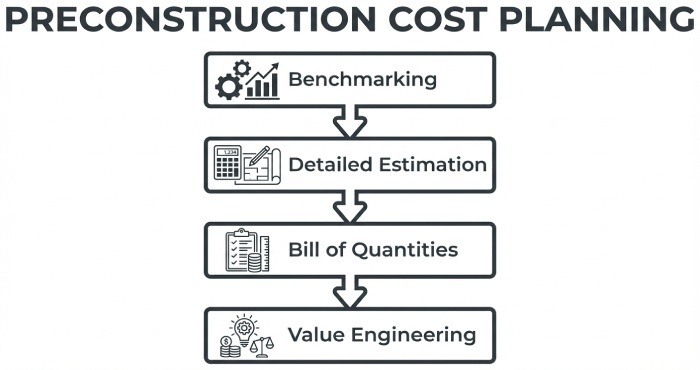
Preconstruction Cost Planning
Preconstruction shapes commercial certainty in the construction industry. Effective planning converts design intent into a defendable cost estimate and a pragmatic delivery strategy that underpins project budgeting.
Benchmarking, estimating, and early feasibility
- Use market benchmarking to anchor financial feasibility studies and align construction costs with investment targets.
- Progressively detail the cost estimate (order-of-magnitude to elemental to detailed), ensuring auditable assumptions and escalation.
- Test constructability and logistics early; in contracting, sequencing and productivity indices are pivotal drivers of a realistic cost estimate.
Bills of quantities, procurement strategy, and value engineering
- Prepare a robust bill of quantities (and full bills of quantities for major packages) to standardize pricing, support tender documents, and enable later valuation of construction work.
- Shape a procurement strategy that times the market, balances fixed-price versus remeasurable risks, and aligns with subcontractor capacity in the building trade.
- Undertake value engineering with designers and the client, optimizing specifications without eroding performance; update project budgeting and the cost estimate accordingly.
Construction-Phase Cost Control
Once on site, commercial discipline ensures that contracting objectives, cash, and cost align with program realities.
Measurement, progress valuations, and variations
- Maintain meticulous measurement to substantiate progress valuations, interim payment applications, and submission of bills.
- Record and price variations promptly; integrate changes into the live cost estimate and budget control dashboards.
- Support claims management with evidence, programs, and causation analysis; anticipate dispute management pathways under the contract.
Cash flow, cost reporting, and performance tracking
- Forecast cash flow across procurement, labor, plant, and preliminaries to protect working capital for the contractor.
- Issue concise cost reporting: earned value, commitment curves, and risk-adjusted forecasts against project budgeting baselines.
- Reconcile subcontractor accounts and manage final accounts with transparent backups derived from bills of quantities.
Enablers and Frameworks for Effective Cost Management
Technology, data, and governance frameworks amplify the impact of a quantity surveyor in contracting.
Digital takeoff, 5D BIM, and cost databases
- Deploy digital takeoff and 5D BIM to link quantities with time and cost, improving measurement accuracy and scenario testing.
- Maintain curated cost databases for the building trade, including labor norms, plant rates, and commodity trends, to strengthen each cost estimate.
- Integrate CDE-based preparation of documentation so that revisions cascade cleanly to bills of quantities and procurement packages.
Risk, contingency, lifecycle costing, and contract mechanisms
- Apply structured risk analysis to quantify threats and opportunities; set transparent contingencies and drawdown rules in project budgeting.
- Use lifecycle costing where relevant to inform specification choices that minimize whole-life construction costs for the client.
- Select contract mechanisms (lump sum, target cost, remeasurable) that reflect design maturity and market capacity, and align contract management processes to enforce contract conditions.
Practical Guidance for High-Performance Contractor QS
KPIs, dashboards, collaboration tips, common pitfalls, and selection
- KPIs: forecast accuracy (cost-to-complete variance), change latency (days from instruction to priced variation), procurement lead times, subcontractor alignment to program, and cash conversion cycle.
- Dashboards: combine earned value, buy-out status versus the baseline cost estimate, risk burn-down, and claims status to inform prompt actions in the construction industry.
- Collaboration: embed the quantity surveyor in site coordination meetings; connect planners, engineers, and commercial staff to validate measures and sequencing; communicate early with the client on scope creep.
- Common pitfalls: under-measured preliminaries, optimistic productivity, incomplete bills of quantities, and delayed notices under contract conditions.
- How to select a contractor QS: prioritize a Chartered Surveyor or an experienced Professional Quantity Surveyor with demonstrable contracting track record, strong cost analysis skills, and references in similar development projects.
Example dashboard metrics
- Buy-out percentage versus baseline by trade, variation aging, risk exposure versus contingency, and cash-in versus cash-out by month.
Pro tip on earned value
Tie earned quantities directly to WBS-coded bills of quantities for transparent variance analysis and faster recovery planning.
Standards, Credentials, and Professional Bodies
Professional recognition signals competence to manage construction costs rigorously. Many contractor QS leaders are Chartered Surveyor members of RICS (The Royal Institution of Chartered Surveyors) or regional bodies. Pathways include Chartered Quantity Surveyor, Certified Quantity Surveyor, and Professional Quantity Surveyor designations, each requiring professional competence assessment grounded in the surveying profession. Internationally recognized institutions include the Australian Institute of Quantity Surveyors, CIQS and the Canadian Institute of Quantity Surveyors, SCSI (Society of Chartered Surveyors Ireland), RISM (The Royal Institution of Surveyors Malaysia), SACQSP (South African Council for Quantity Surveying Profession), and CICES (Chartered Institution of Civil Engineering Surveyors). Communities such as Quantity Surveyor International support continuous learning for the building trade and contracting practitioners.
Templates, Deliverables, and Preparation of Documentation
To sustain cost management discipline:
- Tender documents: standardized scopes, pricing schedules, and commercial clarifications that map to the bill of quantities.
- Preparation of documentation: measurement rules, revision control, and clear takeoff notes that accelerate tender management and reduce ambiguity.
- Deliverables: trade-by-trade bills of quantities, cost analysis summaries, procurement schedules, and material forecasting registers aligned to lead times and logistics in the construction industry.
Governance, Ethics, and Contract Conditions
A contractor quantity surveyor provides contractual advice that upholds fairness while protecting the contractor’s position. Adherence to notice provisions, transparent valuation of construction work, and ethical sourcing are non-negotiable in the building trade. Broader duties can include reinstatement cost assessment for insurance purposes on refurbishment or fit-out scopes, provided methodology aligns with insurer expectations. Effective contract management balances commercial rights with collaborative behaviors to avoid dispute management and sustain delivery certainty for the client.