
Fire safety auditors are independent Fire Safety Professionals who verify that buildings, operations, and occupants are protected by effective fire safety measures and compliant with fire safety regulations. They blend technical knowledge of fire protection systems with practical experience in code consulting, risk assessment, and fire safety management. Whether they are in-house Safety Inspectors, a Third Party Code Consulting Company, or external fire safety consultants, their goal is to reduce fire hazards, safeguard life safety, and strengthen organizational resilience.
Reputable firms such as Fire Safety Consultants, Inc. (FSCI) perform inspection services and code consulting across occupancies, including plan review, Fire Protection Plan Review, and Municipal Building Plan Review. Fire safety auditors may hold credentials aligned with the National Fire Protection Association (NFPA) and International Code Council (ICC) frameworks; for example, NFPA’s Certified Fire Inspector (CFI) program signals competency in fire safety standards, fire safety management, and enforcement of fire safety regulations. Many auditors also collaborate with organizations such as the National Fire Sprinkler Association (NFSA) and the Automatic Fire Alarm Association (AFAA) to stay current with best practices for fire sprinklers and fire alarm systems.
Why audits matter:
- They verify compliance with fire safety regulations and local ordinances.
- They assess the condition and performance of fire protection systems (e.g., fire sprinklers, fire alarm systems, fire suppression systems, emergency lighting).
- They identify latent fire hazards stemming from operations, hazardous materials, storage, housekeeping, and maintenance gaps.
- They inform building managers about corrective actions and testing schedules that improve life-safety outcomes.
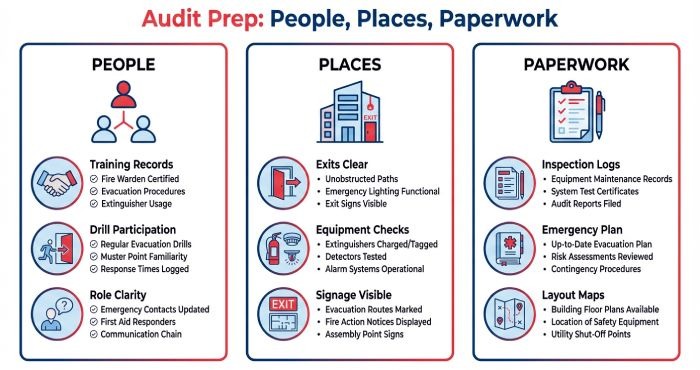
How to prepare: people, places, and paperwork before an audit
Preparation streamlines the fire safety audit and reduces disruption.
People
- Assign a point person (often building managers or EHS leads) to accompany fire safety auditors. Ensure key operators for fire protection systems are available for demonstrations.
- Refresh fire safety training for staff, especially on emergency procedures, emergency escape routes, and fire drills. Brief front-of-house teams and Security on auditor access and escort requirements.
- If you use external fire safety consultants (e.g., iFluids Engineering), coordinate scope and document exchange in advance; see iFluids Engineering’s fire safety audit overview for typical preparations.
Places
- Verify access to all rooms housing critical fire protection systems: fire pump rooms, alarm control panels, riser rooms, electrical rooms, and areas with hazardous materials.
- Clear emergency escape routes and ensure fire doors close and latch. Inspect compartmentation for penetrations around pipes/cables and seal as needed.
- Confirm that fire safety signs and wayfinding are visible and that emergency lighting tests are current.
- Tidy storage and housekeeping to keep combustibles away from heat sources and egress paths.
Paperwork
- Prepare a complete fire safety checklist tailored to your occupancy and the applicable fire safety standards (NFPA/ICC). Include as-built drawings, your fire safety plan, and fire protection plan.
- Gather maintenance records, inspection records, and testing schedules for fire extinguishers, fire sprinklers, fire suppression systems, fire alarm systems, and emergency lighting.
- Compile prior third-party review letters, building plan review comments, and any code consulting correspondence showing how you addressed previous deficiencies.
- If you partner with specialists (e.g., Fire Safety Consultants, iFluids Engineering, Autumn Consulting), align on documentation logistics ahead of the opening meeting.
Inside the audit: walkthroughs, system tests, and documentation reviews
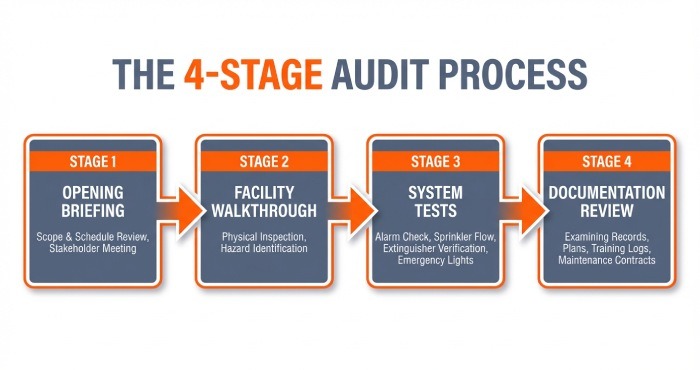
A comprehensive fire safety audit follows a structured flow designed to demonstrate that fire safety measures are in place, maintained, and understood.
Opening briefing
- Scope, facilities included, and methodology are clarified.
- Auditors outline applicable fire safety regulations, local amendments, and the evidence they will sample.
Facility walkthrough
- Fire safety auditors tour representative areas to evaluate life safety features, emergency escape routes, and occupancy-specific fire hazards.
- They confirm compartmentation integrity, verify that fire doors function, and observe the placement and condition of fire extinguishers.
- Where relevant, they assess processes involving hazardous materials and verify control areas, ventilation, and alarms.
System tests
- Functional tests of fire alarm systems, notification appliances, and monitoring are observed.
- Fire sprinklers and other fire suppression systems are reviewed for coverage, impairment management, and recent inspections.
- Emergency lighting and exit signage are spot-tested; annunciation and sequence-of-operations checks confirm performance of integrated fire protection systems.
Documentation review
- Auditors sample inspection records, maintenance records, and testing schedules to confirm ongoing compliance and due diligence.
- They evaluate plan review history, third-party review reports, and close-out documentation for renovations that could affect egress or compartmentation.
For a concise summary of audit components and scope, see this overview of Fire and life safety audits.
Codes, checklists, and common nonconformities that auditors identify
Fire safety auditors benchmark findings against adopted fire safety standards, jurisdictional fire safety regulations, and recognized best practices. Many jurisdictions align with ICC model codes and NFPA standards; state-level authorities (e.g., Offices of the State Fire Marshal) publish additional guidance on fire and life safety.
Typical nonconformities
- Egress and signage: Blocked or reduced-width exits; missing or obscured fire safety signs; emergency lighting failures; exit hardware issues.
- Fire doors and compartmentation: Doors propped open; self-closers disabled; unsealed penetrations in fire-resistance-rated walls; unlabelled or altered fire doors.
- Systems and equipment: Overdue inspections of fire sprinklers, fire alarm systems, fire extinguishers, or kitchen hood suppression; impaired fire suppression systems without impairment permits; missing valve supervision or tamper seals.
- Operational controls: Poor storage and housekeeping; combustibles piled beneath sprinklers; incompatible or unlabeled hazardous materials; gas cylinders unsecured.
- Documentation: Lapses in inspection records; incomplete maintenance records; outdated fire safety plan; missing as-builts for recent renovations affecting egress or fire protection systems.
- Training and drills: Infrequent fire drills; lack of role-based fire safety training, especially for shifts with vulnerable occupants (e.g., healthcare, education, assisted living).
Auditors use a risk-based fire safety checklist to prioritize findings that affect life safety. They also provide code consulting context—citing the governing code section—so Building Managers can see how to restore compliance.
Typical corrective actions and timelines
- Immediate corrections: Clear egress routes; re-enable self-closing fire doors; replace discharged or expired fire extinguishers; post temporary fire watch when systems are impaired.
- Short-term (0–30 days): Seal penetrations restoring compartmentation; repair emergency lighting; schedule overdue tests for fire sprinklers, fire alarm systems, and fire suppression systems; update fire safety signs and evacuation maps.
- Medium-term (30–90 days): Execute work orders from plan review outcomes; revise the fire safety plan; retrain staff on emergency procedures; address hazardous materials segregation; document all actions in inspection records and maintenance records.
- Longer-term: Integrate corrective actions into fire safety management systems; establish recurring testing schedules; commission code consulting or a third-party review after significant modifications to verify compliance and best practices. Visit Metrofire for additional details.
After the audit: reports, corrective actions, timelines, and continuous improvement
Deliverables
- Fire safety report: A structured summary of observations, nonconformities, risk ranking, and references to fire safety regulations. Expect clear corrective actions, owners, and target dates.
- Close-out process: Provide evidence of corrections (photos, work orders, permits, revised drawings). Where design changes are needed, engage plan review, including Fire Protection Plan Review or Municipal Building Plan Review, through your AHJ or a qualified Third Party Code Consulting Company.
Sustaining improvements
- Embed actions into fire safety management: Track recurring tasks (e.g., quarterly sprinkler inspections, monthly extinguisher checks) and verify testing schedules are maintained.
- Strengthen competence: Enroll staff in role-based fire safety training; consider credentials for your internal auditors or coordinators. Participate in practitioner forums such as NFPA Xchange to learn from peers.
- Monitor regulatory change: NFPA and ICC updates can require adjustments to fire safety measures, documentation, and system testing.
Data-driven oversight
- Use metrics (e.g., closure rates, time-to-correct, drill participation) and management reviews to drive accountability.
- Periodically reassess organizational capability with NFPA’s Ecosystem Assessment Tool to benchmark your fire safety management maturity across the elements that influence life safety.
- Engage experienced fire safety consultants for periodic third party review, especially after renovations, occupancy changes, or system impairments.
By aligning day-to-day operations, robust documentation, and informed code consulting with a scheduled fire safety audit cadence, organizations reduce fire hazards, maintain compliance, and ensure that critical fire protection systems are ready when they matter most.